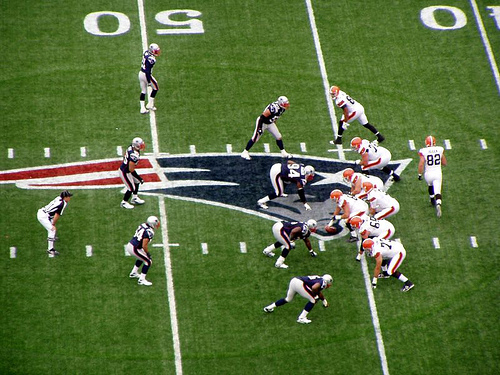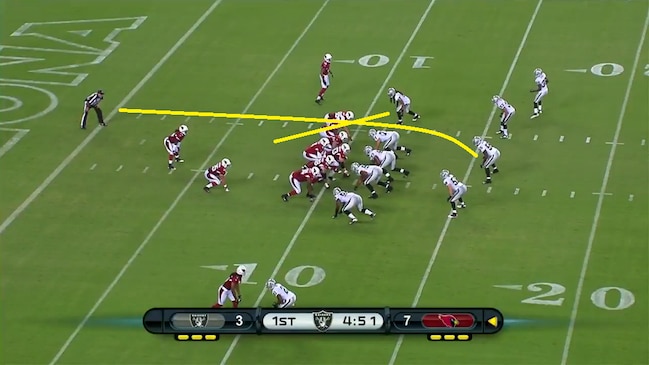
Fundamentals : Defensive Techniques

We’ve spent the past few weeks talking mostly about offensive fundamentals, so today we’re going to switch sides and talk defense.

As the draft approaches, you’re likely to hear commentators talking about defensive prospects in terms of “technique.” Now, to the rest of the world, this sounds like it would be a good descriptor for a player’s particular method of play, right? As in, “he has really solid technique.”

But because football likes to keep you guessing, that’s not at all what it means.

(If you’ve learned anything from this website, you are probably not at all surprised. When it comes to football terminology, nothing is ever what it seems.)

In this set of circumstances, a defensive player’s “technique” has nothing to do with his fundamental skill level and everything to do with where he lines up on the defensive line.

Let’s review where exactly the defensive line is by first reviewing the players on defense:

defense

Here we see the defensive ends and defensive tackle up front on the defensive line, the linebackers behind, and the safeties and cornerbacks in the secondary.

Pop Quiz time!

What defensive formation is this defense running?

If you said 3-4, you’re right! Great job! There are 3 defensive linemen up front and 4 linebackers behind them.

Bonus Question!

There’s only one tackle lined up in the middle of the formation. What is the name for this position?

It’s, of course, named by the corresponding facial feature (of course!): the nose tackle. Mysterious Football Lingo strikes again.

Ok, moving on: to make it a little easier to see which area of the defense is where, here’s a color-coded copy:

defensive zones

So when we’re talking about defensive techniques, the only players in question are the guys all the way up front on the defensive line: the defensive ends and tackles.

As mentioned above, a technique is solely the lineman’s position on the field.

[hr]

Techniques are identified by numbers, starting with zero, and increase from inside to outside (almost always – this is still football, after all). Even numbers are D-linemen lined up directly over their corresponding offensive linemen. Odd numbers indicate D-linemen lined up to the outside shoulder of the O-linemen.

[hr]

There are two schools of thought when it comes to numbering defensive techniques. One is more confusing than the other, so we’ll start there:

football, fundamentals, techniques

image source

The line shown in shapes isn’t the defensive line; it’s the offensive line. The square C is the center, then the guards, then the tackles, and the TE is the tight end. The numbers indicate the defensive techniques.

You can see that the even numbers (0, 2, 4, 6) are all lined up directly across from an offensive lineman. On the occasion that a defensive lineman would line up inside an offensive lineman’s shoulder, the technique is marked by an “i” for inside (2i, 4i). The alignments that occur on the outside of the offensive lineman’s shoulder are marked by odd numbers (1, 3, 5, 9). The exception to this rule is the tight end: the inside position is marked by a 7, and the outside position is marked by a 9. In this example the tight end is on the offensive right of the formation, but were he on the offensive left instead, the same numbers would still apply – 7 for inside, 9 for outside. You’d think, logically, that the numbers for this alignment would be 7 for the outside, 6 for over top, and 6i for inside, but that’s not so. I kind of love the explanation given by Georgia Tech head coach Paul Johnson for how this came about: “No one knows why that is the case but Coach Bryant numbered it that way and no one has the guts to change it.”

Coach Bryant is Bear Bryant, legendary Alabama head coach. I can understand why no one thought it best to make the tweak.

Someone, however, must have had the guts to make the tweak somewhere along the line, because there’s another system of numbering that works much more sensibly:

football, fundamentals, technique

image source

In this system, the zero technique is still aligned directly over the center. From there, techniques are assigned numerically down the line from 1-9 (if a tight end is present) or 1-6 (if no tight end is present). Even though it doesn’t follow the “even lines up over” rule, it’s still a little easier to follow.

So despite the systems being a little wonky, once you get past that, it’s not too bad, right?

Now the question is: who goes where? What type of player fits the mold for each technique? Let’s consider that in terms of odd-numbered techniques (except for zero), the ones most frequently used to describe defensive linemen:

0-technique: usually the biggest guy of the bunch. He’s traditionally (but not always) responsible for blocking the center and defending both A gaps, so he’s got to be large enough to take up a lot of space on the field.

1-technique: similar physique and job description as the 0-technique, but he usually defends one gap (the A gap), not two, and should command attention from both the center and the guard.

3-technique: the lineman aligned in this position is poised for disruption. It’s his job to shoot the B gap and get into the backfield to disrupt any running or passing plays. As per Pro Football Focus (which is a must read for more information about these techniques – or about anything football, for that matter): “Unlike the first two tackle positions, the 3-technique relies far more on speed and agility than brute strength.”

5-technique: this alignment is designed to block the B and C gaps, not so much through size, but through length. The 5-technique player is usually large, but also tall.

7-technique: it’s all about setting the edge and stopping the run for the 7-technique player. In the case of a passing play, the lineman in this position should also be able to elude the tight end and the tackle and get into the backfield to disrupt a passing play.

9-technique: these are the speed rushers; the guys who are going to fly off the defensive line and into the backfield to rush the quarterback.

So, what do you think? Clear as mud? I know we kind of dove into gaps in this post as well, and I don’t think we’ve talked about them before – consider that your spolier alert for next week’s fundamentals post :)

Fundamentals : Plays

(If you missed the post about schemes and the post about formations, you might want to go back and read those first. Then come back and join us for today’s post about offensive play calling: the key to finally understand what the quarterback is shouting about at the start of the play! See you soon!)

Have you always wondered what the quarterback is doing when he gets behind the center and starts shouting, “BLUE 42! BLUE 42! HUT HUT!” It sounds like Red Rover, the Remix.

While it might sound like the QB has gone off his rocker, what he’s actually doing is giving the offense the play at the line of scrimmage – delivering specific instructions to let each man know what he’s responsible for at the snap of the ball. We might not be able to crack that exact code of “Blue 42” – each team has specific lingo for the terms in their own playbook – but we can start to understand plays a little bit better by breaking down some of the larger concepts. Today we’re going to focus solely on learning more about play calls for passing plays. Here are 4 keys to breaking down the call:

1. Know the Routes

The number and name of the routes can change depending on the team and the system, but in general, you’ll find that these routes are commonly run by receivers in the NFL:

  1. Quick Out (Flat): a short route in which the receiver runs upfield momentarily and then cuts out to the sideline
  2. Slant: a short route in which the receiver runs upfield at a 45 degree angle before slanting to the sideline
  3. Out: the gold standard in NFL routes, run exactly like the quick out but 10-15 yards further upfield
  4. In (Dig): an out route, run to the inside – so instead of running 10-15 yards upfield and breaking to the sideline, the receiver runs upfield and breaks to the inside
  5. Curl In: the receiver runs upfield and then comes back downfield toward the inside of the field
  6. Curl Out (Comeback, Hitch): the receiver runs upfield then comes back downfield toward the sideline
  7. Corner (Flag): the receiver runs all the way upfield at a 45 degree angle toward the corner of the end zone
  8. Post: the receiver runs all the way upfield toward the outside goal post
  9. Fly (Go, Fade): the receiver runs straight upfield as fast as possible

2. Know the Route Tree

This is more than a little subjective, because route trees are dependent on the number system and route names that a team is using in their own system. But this image is a great starting place to see how the route changes depending on which side the receiver is on:

football, fundamentals, basicsphoto source

(We didn’t talk about the screen pass above – but it’s a pass used when the QB is under constant pressure. He drops back as if he’s going to throw a bomb downfield, the offensive line allows rushers to blitz, and the QB throws a screen pass to an open receiver who has cut behind the offensive line.)

3. Know the 1, 2, 3 and the X, Y, Z

Each member of the backfield has his own number when it comes to play calling – and it’s not the number on his jersey.

1 = Quarterback

2 = Tailback (the running back who will most likely carry the ball)

3 = Fullback (the running back who will most likely block for the tailback)

Each of the receivers also has an identifier – but it’s a letter, not a number:

X = Split End (the receiver who is on the opposite side of the tight end)

Y = Tight End (or the slot receiver if the tight end isn’t in the play)

Z = Flanker (the receiver who is on the same side as the tight end)

Confused? This should help:

Route Cropped

We know from our formations fundamentals that this is an I formation – the backs are all aligned in a straight line behind the center. The fullback, 3, is in front of the tailback, 2, because he’ll be blocking for the tailback. The X receiver is split out to the side of the formation that the tight end isn’t on, the Y receiver is the tight end, and the Z receiver is aligned a few yards behind the tight end so that there are only 7 men on the line of scrimmage (any more than that is an illegal formation).

4. Know how to translate the play call

Ok, so now that we know the pieces, how do we put it all together into a play?

We start by knowing this: the first half of the play call refers to alignment, the second half refers to routes. 

Let’s say the play call is “I Right 459 Tailback Slant.” We’ll break it down piece by piece:

I = I formation. This tells the backs where to line up.

Right = Tight end on the right side

Now that the alignment is set, the routes are declared. The numbers go in order of X, Y, and Z and tell the receiver which route to run. So in this example, assuming that we’re using the route tree in the picture above, 459 equals:

4 = the X receiver runs an In route

5 = the Y receiver runs a Hitch route

9 = the Z receiver runs a Go route

The numbers always refer to receivers. If a running back is going to be added into the passing play, his route will be spelled out afterward. In this play, the tailback is going to run a Slant route.

If you think that’s a mouthful, try learning the verbiage of a west coast offense. They usually spell everything out, so that play would be “I Right X In Y Hitch Z Go Tailback Slant.”

So where do the colors come in? Usually, that’s a whole other barrel of monkeys called a “hot sheet” or a list of audibles (play changes at the line of scrimmage) that get coded with numbers and corresponding colors. That’s where “Blue 42!” from above would fit in. I’m going to spare your brain, and mine, and save that lesson for another day.

Gang, how do we feel? Does this all make sense? Do you feel ready to coach and call the plays?

Fundamentals : Formations

So for the past two weeks we’ve talked about schemes, or the overarching philosophy of a unit (in our case, the offensive unit). We learned about five basic schemes and dove a little deeper into the waters of this whole option offense movement in the NFL. Today, we’re moving onto formations – and you’re in luck! We’ve already been over this and you may not have even known it!

If a scheme is the meal (breakfast), a formation is the dish of choice (pancakes). We’ll talk more about plays next week, which are the specific ingredients that make everything come together (flour, milk, butter, syrup).

So what’s a formation? It’s how players are aligned on the field at the snap of the ball. Formations aren’t just isolated to offense; the defense and special teams units have specific formations that they use as well.

Think it sounds complicated? Not at all! In fact, we’ve already covered most of this in different contexts. You’ll fly through this in no time.

Here are a few common formations that you’ll see on offense and defense:

Offensive Formations

Shotgun Formation

We learned about the shotgun formation when we talked about snaps a few Fundamentals posts ago. In the shotgun formation, the quarterback takes the snap from between 5 to 7 yards behind the Center. It looks like this:

photo source

See how far back Phillip Rivers is? He’s taking the snap from the shotgun formation, 5-7 yards behind the Center.

Moment of truth: we can also determine the basic offensive scheme the Chargers are running in this play just from looking at this picture. Go ahead and give it a try!

If you guessed spread offense, you’re right on. It’s spread and not spread option because there is no one in the backfield to run the ball; all of the receivers are spread out along the line of scrimmage so this is a passing play with no option for the run.

Split Back Formation

Oh, people! Look at this! Way back when we talked about personnel groups, little did we know we were actually looking at a split back (or pro set) formation:

PG Example 1

Now, if I’m correct, I think that the split back formations of yore have the quarterback taking the snap from under Center. However, as a broad definition, a split back formation is when there are two running backs on either side of the quarterback, lined up behind the offensive guards on each side.

I-Formation

The Packers are going to help us out with this one:

photo source

The I-formation is an easy one to figure out, since the players literally line up in an “I” behind Center. The quarterback and running backs form a straight line back in this classic formation.

Defensive Formations

3-4 Defense

Oh, hey! Guess what! We know this one too, from our Basics of Defense lesson:

football, defense, basics

In a 3-4 formation, there are 3 defensive linemen up front with 4 linebackers behind them. Hence: 3-4.

You’re going to rock at the 4-3.

4-3 Formation

If you’re guessing that this formation employs 4 defensive linemen up front with 3 linebackers behind them…you win! That’s 100% right:

photo source

See? 4 up front, 3 behind.

Moment of truth, defense: We know from last week’s film room post that one corner is playing man coverage and the other is playing zone.

Isn’t knowing that such a thing of beauty?

Ok, now let’s throw a little caution to the wind here, because you have to be careful with this whole 3-4/4-3 business. Some tricksters, like, say, the Hoodie, throw a few surprises into the mix:

photo source

That’s a 4-3, right? Nope, not in this case. See that 4th defensive player on the left up front? See how he’s in a 2-point stance (standing up), not a 3-point stance (one hand on the ground)? That’s because he’s a linebacker. He’s just playing on the defensive line on this play; he’s not one of the defensive linemen. This is still 3-4: 3 linemen, 4 linebackers, even though it looks like 4-3. The linebacker who is up front in this play probably isn’t going to act like a lineman – he’s not going to help block the offensive line – so he’s not part of the linemen equation. There are still 3 linemen, 4 linebackers.

Does all of that make sense?

If not, leave any and all questions in the comments below and we’ll chat about what’s still muddy!

Fundamentals : Option Offense

football, basics, optionChances are you’ve heard a thing or two about option offenses recently, maybe through terms like “pistol” or “zone-read” or “triple option,” or maybe through the breakout players who run these systems, guys like RG3 and Colin Kaepernick and Russell Wilson, or college-turned-pro coaches like Pete Carroll and Chip Kelly, who are bringing these offenses into the NFL. The general consensus is that these types of option-based offenses are just fads and will take a back seat, as all fads eventually do, to the traditional pocket-passer model.

But whether option systems are here to stay or just here for a season, they will undoubtedly play a huge role again in 2013 since they were so successful last season. Today we’re going to spend some time looking at the basic basics of option systems (because to do an in-depth look would require me to quit my job and study playbooks full-time). (Which I would totally be up for, in case anyone is looking to hire for that position.)

So..what is an option offense?

An option offense isn’t so much a specific system as it is a blanket term for a variety of systems that use option principles.

So…what does that mean?

In a traditional, pro style offense, the offense goes to the line of scrimmage knowing what the play is going to be, unless the quarterback decides to audible (change the play at the line of scrimmage). One way or another, unless it’s a designed quarterback-keep play, the quarterback is going to give the ball to someone else after the snap.

In an option offense, the quarterback goes to the line of scrimmage with the option to run/pass the ball or hold onto it himself. 

Traditional Offense = Quarterback Hands Off or Throws

Option Offense = Quarterback Hands Off or Throws or Keeps It Himself

So far so good, right?

You can see right from the get-go why NFL teams haven’t liked this system in the past – it puts their quarterback, who is often the livelihood of the entire team – at much greater risk for injury. When he’s handing off or throwing he’s protected by the offensive line. But when he keeps the ball and runs down the field he becomes a running back, making it legal for defenders to tackle him just like any other runner.

Thus the concern over whether RG3-esque quarterbacks who take frequent hits will be able to achieve longevity in the league. It’s something we won’t know for a few years yet, if these systems stick around that long. (And for what it’s worth, I’m guessing they will.)

Moving on: from this basic option principle we now have a litany of option offenses with accompanying formations and plays, each with their own individual spin on the concept. We could be here until next week going over each and every one, so let’s take a look at a few of the most popular.

*Note: You won’t find an NFL team that is exclusively committed to one scheme. Teams and schemes are polygamist marriages. A team blends together several different schemes that best fit their players and their objectives. Even the teams that run predominately option offenses, like the Seattle Seahawks, still run quite a few plays out of a pro-style offense. That being said, most of what we’re going to be talking about it run out of a spread offense scheme. 

The Spread Option

The spread option offense is what it sounds like – a system that spreads players out across the field. Offenses running the spread option will typically have multiple wide receivers lined up in a wide alignment that spans the field with few to no running backs in the backfield. It’s all about numbers with the spread: if the offense can put 9 guys up front spread out across the field and then further confuse a defense through misdirection and a mobile quarterback, then it’s going to be a tall order for the defense to prioritize which part of the field and which players it’s going to protect most. In the spread, the quarterback takes the snap from shotgun – a formation in which he is aligned at least 5 yards behind the center.

Shotgun formation

photo source

The Pistol

In the pistol, the quarterback lines up closer to the center and has a running back directly behind him. This way he is much closer to the line of scrimmage and can read the defense from up front, choosing to either hand the ball off, drop back and pass, or make a quick sprint through a hole in the defense while keeping the ball.

(I’m sad to say I know the latter all too well after watching Niners QB Colin Kaepernick annihilate the Packers front 7 in the divisional round of the NFC Championships.)

Pistol-formation

photo source

The Zone Read

Once again, the name is indicative of what’s going to happen here: the quarterback needs to read the defense to decide what he’s going to do with the ball. What is he reading? Primarily, the defensive end on the side where he plans to run. If the defensive end “crashes” – runs straight into the backfield in anticipation of a quarterback keep – he gives the ball to the running back. If the defensive end “stays home” – stays toward the outside where he’s aligned – the quarterback keeps the ball.

(Whew.)

What do you guys think of the option offense? Is it here to stay?

Fundamentals : Five Common Offensive Schemes

For the next few weeks we are going to be all about offense. Specifically, we’re going to be talking about schemes, formations, and plays.

It wasn’t that long ago when all of the above sounded interchangeable to me. Isn’t a scheme the same as a formation the same as a play? Nope! Here’s how it all breaks down:

football, basics, schemes

So first comes scheme, then comes formation, then comes plays. Got it? Let’s move on!

Today, we’re going to be focusing on defining a few of the most common offensive schemes. Just as a note – a team’s scheme isn’t like a team’s name: it’s transient. Just because a team runs one scheme primarily doesn’t mean they only run that scheme – most teams run a combination of schemes throughout the course of one game. We’ll spend more time in the next few weeks going over specifics, but for today, here’s a general introduction to five schemes you are guaranteed to see in the NFL:

Pro Set (or Pro Style) Offense

It won’t come as a huge surprise, given the name, that this is the offensive scheme most pro teams run. Even if they don’t exclusively operate out of a pro style offense, they usually run at least some plays out of the pro set. In this scheme, the offense has the option to run or pass. The QB takes the snap from under center and can either hand the ball off to a running back or drop back and pass to a receiver. You’ll recognize it instantly on the field and on paper because it’s a very classic offense in the NFL – QB under center, RB’s in the backfield, WR’s split outside. Here’s what it typically looks like:

Pro Set formation

image source

West Coast Offense

The West Coast Offense, pioneered by Bill Walsh back in the glory days of San Francisco, isn’t so much an alignment of players as it is an offensive strategy. Teams running this offense use a combination of short-yardage passing plays to open up the opportunity for longer-yardage running and passing plays. Instead of advancing the ball by running first, as in the traditional model, the West Coast Offense utilizes short-yardage passing plays to advance the ball.

Option Offense (Spread, Read/Zone, Pistol)

This is the talk of the town in the NFL right now. The Option Offenses, which until quite recently were regarded as college, not pro, offenses, made quite a splash in the NFL this season. Rookie QB’s Russell Wilson and RG3 along with first-year and Super Bowl starter Colin Kaepernick all run option style offenses, and they all had phenomenal seasons. Is the option here to stay or is just a fad, like the short-lived success of the Wildcat? Only time will tell, but until then, we’ll have a lot of exciting games to watch.

So, what is an option offense? We’ll be talking much (MUCH) more about this in weeks to come; there’s just too much to dissect in a single blog post. In short, Option Offenses do exactly as their name suggests: they give the QB several options of plays to run – plays which he decides on both prior to the snap and during the course of the play. It’s a complex system and necessitates a savvy, athletic quarterback who is quick to make sound decisions and able to run or pass on the fly.

No Huddle Offense

This style of offense, like the West Coast Offense, isn’t so much about alignment as it is about execution. In the No Huddle, teams do just that: they don’t huddle up before the play. Instead, they rely on the quarterback to disseminate information about the play while the team is on their way to the line of scrimmage or they can also go with a predefined combination of plays in succession. The advantage of the No Huddle is to never give the defense a chance to catch their breath. Not only will they tire more quickly, they’ll also have far less time to make adjustments and run their preferred defensive schemes. The New England Patriots are the best in the biz at executing a No Huddle offense effectively.

Hurry Up Offense

While similar to the No Huddle, the Hurry Up Offense is different in that it is usually run in the final minutes of the half, not regularly throughout the course of the game. Teams often go into Hurry Up mode when they need to preserve time on the clock and get down the field as fast as possible.

While this is certainly not a definitive list of NFL schemes, you’re more likely to see these than most. Next week, we’ll dive a little further into the option schemes and see what all the commotion is about!

Personal Quiz: now that you are more familiar with these schemes, can you pick the one your favorite team uses the most? If you’re not sure, look it up and learn more about it! You’ll appreciate the offense in a whole new way!

Fundamentals : The Snap

The snap is not found on a winter jacket. Nor is it a dance move inspired by Legally Blond. In football, the snap is one of the most important exchanges that happens in game.

If you’re not watching closely, it might seem as if the quarterback has the ball in his hands from the start of the play and just does with it as he pleases. But this is not true. The center – literally the guy in the center of the offensive line – has the ball at the beginning of the play. He sets it on the ground and puts his hand on it like so:

photo source

(Team choice completely unbiased.)

Once he gets set, he’ll tilt the ball at a bit of an angle so that he can get a good grip. If at any point the center’s head is lined up ahead of the football, that’s an encroachment penalty, which would back the offense up 5 yards.

Types of Snaps

The action of a snap never changes: one player is going to “hike” the ball between his legs to another player, which essentially means that the ball is going to go from in front of him to behind him. How that happens depends on the play at hand. Generally, there are two snaps that happen in classic offensive formations:

1. Under Center

If the QB takes the snap under center, he’s literally standing right behind the center, with his hands in a personal location under the center’s rear end. Here’s Joe Flacco and Matt Birk getting to know each other a little better:

photo source

2. From the Shotgun

In the shotgun formation, the bonding session between quarterback and center is eliminated. The QB is lined up a few yards behind the center, and the center hikes the ball back to him from the line of scrimmage. Here’s Tom Brady and Dan Koppen embracing their personal space:

photo source

Just to be confusing, there’s also a few other forms of snaps to add to the list:

3. Direct Snap

Sometimes, teams run a special formation called the Wildcat formation in which a player other than the quarterback (usually a running back) receives the snap. When this happens, it’s called a direct snap.

4. Indirect Snap

Or, the sneaky version of the direct snap. In this snap attempt, the quarterback is standing next to or near a running back and from all appearances it looks like the QB is going to be the one receiving the snap. But what actually happens is the center snaps the ball to the running back while the quarterback fakes that the snap either went over his head or was fumbled. This happens most frequently in punting situations when the offense wants to try to convert the down rather than continue with the punt.

5. Long Snap

Centers don’t get to have all of the fun. The Special Teams unit – the unit responsible for kicking plays – employs a specific player just for snapping the ball called the longsnapper. It’s his job to make those long snaps effectively every time. (He can usually also be a backup offensive lineman if need be.)

Bad Things That Can Happen

In every snap’s life, a little rain must fall. Snaps can be fumbled – when the football gets mishandled and leads to a failed secure exchange between QB and center. There can also be illegal motion, encroachment, or false starts at the time of the snap – when players are not set, lined up correctly, or moving too soon when the ball is being snapped. If the ball isn’t snapped before the play clock expires, that’s a delay of game penalty and will cost the offense 5 yards. There are a litany of other rules regarding what happens surrounding a snap, but those are three situations you’ll see more than most.

Snap Counts

If the center snapped the ball on the same signal on every play, the defense would catch on quickly and be able to anticipate the snap, therefore getting the fastest possible start. To keep the defense from gaining any advantages, quarterbacks use a snap count, or a designated signal (either verbal or nonverbal) on which he wants the ball to be snapped. Teams often try to confuse a savvy defense by using a hard count – a fake snap count designed to draw the other team offsides.

Questions, comments, concerns, something I left out? You know where to find me!