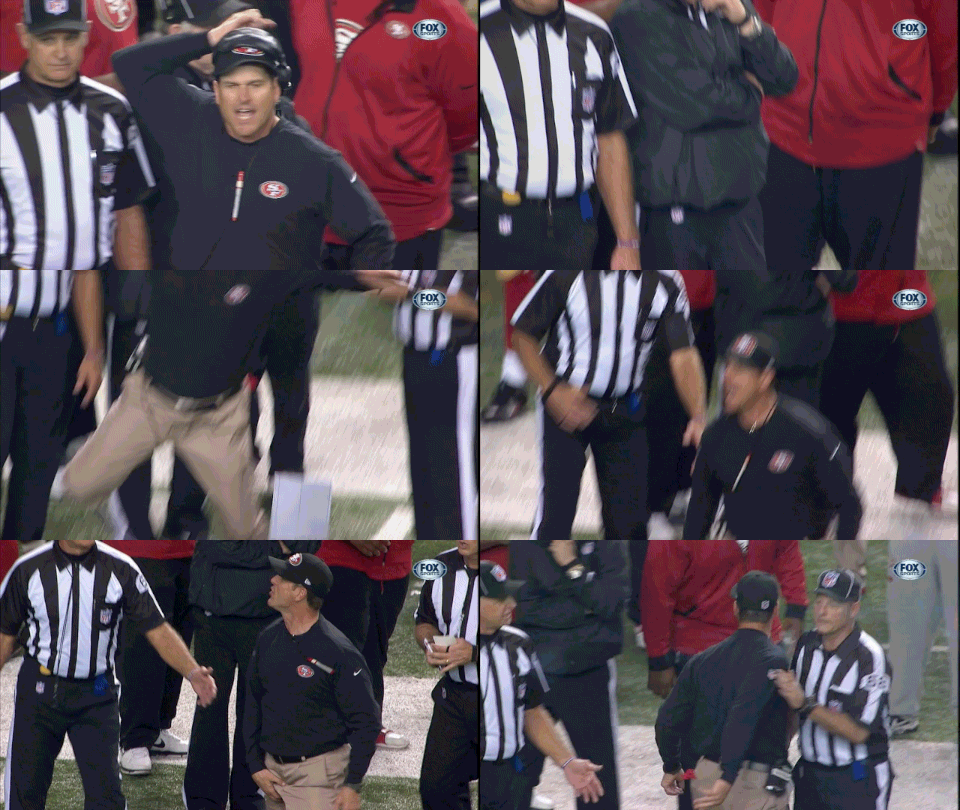
Best of What Just Happened : Catch?

Originally posted here on January 21, 2013

Late in the Niners at Falcons game last night, Falcons receiver Harry Douglas kept the Falcons Super Bowl hopes alive with a big catch late in the game.

Or was it?

It’s one of those plays that is virtually impossible to call, especially since what defines a “catch” has changed in recent years. In days gone by, a catch wasn’t a catch unless the ball was completely controlled by the receiver. If there was any movement and it looked like the ball hit the ground, it was probably going to be ruled incomplete. But recently, it seems like the calls tend to favor the receivers.

Be that as it may, here’s what happened:

Douglas appears to have control of the ball all the way to the ground. Once he goes to the ground…it’s unclear. While the ball does move around a bit, his left hand seems to cover the ball at all times, indicating that he never lost control of the ball. Consequently, the refs called it a catch.

Jim Harbaugh subsequently flipped out, which is so out of character for him. He then threw the challenge flag.

One thing to note about challenged calls – there has to be indisputable evidence that the call was wrong to be overturned. In the face of mediocre (aka: inconclusive) evidence, the call is going to stand every time.

Since there wasn’t clear evidence that the ball came out and hit the ground while outside of the receiver’s control, the call stood.

Luckily, Jim Harbaugh didn’t lose his cool.

It ended up not giving the Falcons an advantage anyway though, since the Niners got a huge fourth-down stop and the Falcons turned the ball over on downs.

What do you guys think? Catch or not a catch?

Best of What Just Happened : Fumble Recovery

Originally posted here on January 7, 2013

Another week, another chat about flaws in the Coach’s Challenge system.

Early in yesterday’s Colts at Ravens playoff game, Ravens running back Ray Rice fumbled the ball, the Colts recovered it, and then a Ravens player emerged from the pile with the football.

So, sequence: Ravens fumble, Colts recover, Colts lose possession, Ravens dig it out and re-recover it.

The official call: Colts football.

Now at first glance, this is a weird call. If a player emerges from the bottom of a pile with the football, you’d assume he had the final possession of the football. But more often than not things get ugly at the bottom of the pile and players scrap for the ball even after the play is dead (when the whistle has been blown) to try and get possession. So in that light, it would make sense that the official (Mike Carey) who called Colts ball saw more than we did on TV and knew that the Colts had possession of the ball when the play was over, not the Ravens.

However, on second glance, it looks like the original sequence was right on: Ray Rice fumbled, the Colts recovered but lost the ball, and the Ravens re-recovered the ball at the bottom of the pile. It seemed like pretty solid evidence that if reviewed, the ball would be given to the Ravens.

But Ravens head coach John Harbaugh couldn’t do anything about the bad call. Remember what we learned about the Coach’s Challenge system? There are a bunch of plays that coaches can’t challenge, including fumbles. So even though it was clearly a bad call, the Ravens just had to get over it and keep playing (which they did, to the tune of a turnover of their own later that drive).

Next week, we’ll talk about something other than the issues with the Challenge system. Promise.

Best of What Just Happened : Punt

Originally posted here on December 17, 2012

In last night’s Niners at Patriots game there was a substantial debacle over a potential muffed punt.

Between multiple fouls and Ed Hochuli’s classic method of explanation and his microphone cutting in and out due to inclement weather…it was one big confusing mess. Honestly, I’m still confused. But let’s try to break it down as best we can:

What Happened:

The Patriots punted the ball on 4th down. Ted Ginn Jr., a member of the 49ers special teams unit on that particular play, appeared to have potentially touched the football as the ball hit the ground and was bobbling around. The Patriots then appeared to have recovered the ball.

What That Means:

Members of the kicking team (the team that is punting the ball) cannot touch the ball before a member of the receiving team (the team receiving the punt) touches the ball. If they do, it’s a violation. However, if a member of the receiving team touches the ball but does not have possession of the ball (doesn’t catch it or have it in his hands) the kicking team can legally recover the ball (by falling on it or picking it up – any way of gaining possession) and therefore gain possession.

Terms To Know Before We Get Down To The Nitty Gritty:

muffed punt is when a player touches the football prior to possessing the football. This can happen when the football inadvertently hits a member of the kicking team, or, as in our example, the football touches a member of the receiving team but is not possessed by that player.

An illegal touch (which I believe is synonymous with first touch) is when a member of the kicking team touches the football before a member of the receiving team touches the football. This is a violation, not a foul. (I’m still working on it, but I think the difference between a foul and a violation is that fouls are flagged penalties and violations are not flagged but are leveraged against the team committing the violation.)

Downing the ball is when the ball hits the ground and a member of the kicking team touches it to “down the ball” – or have it called dead – right where it is. You usually see this when a punter pins the ball deep into the opposing teams territory and members of the kicking team attempt to keep it from rolling into the end zone. If they down the ball before it reaches the end zone, it will be positioned wherever they downed it (the 5 yard line, the 2 yard line, etc), but if it goes into the end zone it is ruled a touchback and will be brought out to the 20 yard line, which gives the other team much better field position.

Confusing and not relevant to our current conversation but IMPORTANT:

Downing the ball DOES constitute an illegal touch. However, since it’s a violation and not a foul, it doesn’t carry adverse consequences for the kicking team. If the kicking team downs the ball, it is an insurance policy for a receiver on the receiving team who may want to pick the ball up and return it. Since downing the ball is an illegal touch (first touch) violation, the ball will automatically be spotted at that position (or at the most advantageous position for the receiving team if there were multiple first touches) if the receiver does decide to pick up the ball and return it and fumbles it or loses yardage in the process.

The Result:

Let’s go back to the play in question. The Patriots punted, it looked as if the ball may have touched a 49ers player, and the Patriots recovered the ball. (We’re not even going to get into the other penalties called on the play because illegal touching can’t offset any penalties (because it’s a violation, not a foul) so they were going to stand anyway.)

Bill Belichick thought the punt was muffed. We learned above that a muffed punt is when a player from the receiving team, in this case, Ted Ginn Jr. of the 49ers, touches the ball before possessing the ball. Upon further review, it was decided that the punt was not muffed – it did not touch Ted Ginn Jr. before being touched by the Patriots.

MINI QUIZ:

Now we have a situation in which the kicking team touched the ball before the receiving team had a chance to touch the ball. And what does that mean?

You got it! Illegal Touching/First Touching by the Patriots, which results in the 49ers getting to choose the most advantageous first touch to spot the ball.

Here’s the actual rule that was cited in the call:

” ‘First touching’ is when a player of the kicking team touches a scrimmage kick that is beyond the line of scrimmage before it has been touched by a player of the receiving team beyond the line. If the ball is first touched by a player of the kicking team, it remains in play.

“First touching is a violation, and the receivers shall have the option of taking possession of the ball at the spot of first touching, provided no penalty is accepted on the play, or at the spot where the ball is dead. First touching does not offset a foul by the receivers. There may be multiple ‘first touch’ spots, if more than one player of the kicking team touches the ball before it is touched by a player of the receiving team.”

And there you have it: the most confusing way to start a Monday. Holy cow.

Best of Game Play Thursday : All About Clocks

I’ll be taking a few weeks off from posting new content to gear up for the upcoming season (!!!), but since there’s a whole bunch of content that kind of whizzed by this past year, I’ll be reposting some of the best and brightest until we resume again in time for preseason in early August. If you need to get in touch in the meantime, please don’t hesitate to contact me!

You’re watching a game. There are 12 minutes left in the 4th quarter. But while the quarterback is making changes at the line before the snap, there is a little clock that is ticking down a dwindling number of seconds. The game clock says 12:00, but the other clock is counting down 5…4…3…2…before the quarterback motions for the snap and the play begins.

So, what gives?

There are two clocks running during every football game, and they each calculate different expanses of time. Just to make life more interesting.

The clock that counts down the time remaining in each quarter is the game clock. There are 15 minutes in each quarter. Once started, the game clock only stops:

  • when an incomplete pass is thrown
  • when a player with the ball runs out of bounds
  • at the end of a kicking play, a scoring play, or a quarter
  • when an official review is needed (measurement, replay, challenge, etc)
  • when a penalty is called
  • when an injury occurs
  • when a timeout is called (um, duh)

The game clock does not run during extra point attempts, even if a team decides to go for two.

*There are a few caveats to the main clock-stoppage plays as described above, but those are the primary plays in which the clock will be stopped. 

The play clock counts down the amount of time a team has to get a play started. You usually only see it (up by the scoreboard or electronically placed on the field) when time is close to running out. A team has 40 seconds from the end of a previous play to start the next play, unless it is one of the following situations, in which case the play clock is set to 25 seconds:

  • a change of possession
  • a charged team time out
  • the 2-minute warning
  • the end of a quarter
  • a penalty is called
  • an extra point attempt
  • a free kick

So unlike the game clock, the play clock does run during extra point attempts. It’s helpful to note that the game clock and the play clock are not always running at the same time.

Just in case you wanted to be thrown for another loop, here’s this: For most of the game, the play clock stops when a player goes out of bounds and is restarted once the officials spot the ball at the correct yardage marker. But during the last two minutes of the first half and the last five minutes of the second half, the play clock stops when a player goes out of bounds and doesn’t restart until the ball is snapped on the next play.

The NFL: Making Life Complicated Since 1920.

Need help remembering all of this?

  • The game clock keeps time for the game as a whole, and only starts and stops – the length of time isn’t added to or subtracted from (unless there’s an error).
  • The play clock keeps time in between plays and is almost always running – the length of time it’s set to (25 or 40 seconds) can change depending on the play.

So what’s up with the mini clock that’s counting down quickly when there’s still 12 minutes left in the game? That’s the play clock. If the offense doesn’t get the ball snapped before the time on the play clock expires, they will be charged a delay of game penalty, which is a 5-yard penalty.

Make sense?

This is where clock management comes into play. In a nutshell, clock management is using the time on the clock effectively – the game clock and the play clock – to put your team in the best position to win. The responsibility of clock management falls mainly on the quarterback, through the leadership/play calling of the head coach. If there are only 10 seconds left on the play clock, the quarterback needs to call out the play and get everyone set on the line of scrimmage immediately before the clock runs out. It’s each player’s responsibility to get the play and get lined up effectively, but the quarterback needs to orchestrate that sequence.

Have you ever heard commentators talking about a “2-minute drill”? That’s clock management as well. If a team is behind with a short amount of time left in the game – about 2 minutes or so – they usually have a set plan for how to proceed in a way that will lead to a win. That’s not to say that it will work, but the 2-minute drill is practiced every week to ensure that everyone is on the same page for clock management and play calling at the end of the game.

Clock management isn’t just for teams that are losing at the end of the game. Teams also practice 4-minute drills to run out the clock at the end of the game if they’re on top so that the other team doesn’t have a chance to get the ball back with a lot of time left to work with. Running time off the clock usually entails a lot of running plays – they take more time off of the clock because they are often short-yardage plays in which players stay in-bounds, so an effective running team can take lots of time off of the clock by slowly but surely plowing down the field.

You’ve surely also heard this at the end of almost any game: “And with that, the (insert team here) can run out the clock,” and this signals that the team will win the game without running any more plays, besides the quarterback kneeling down in victory formation several times. Why?

Two minutes = 120 seconds, right? You know what also equals 120 seconds? Three expirations of the play clock. 40 seconds x 3 downs = 120 seconds. So if the team in possession of the football at the 2-minute warning has the lead and a first down and the other team is out of time outs and therefore can’t stop the clock, the team with the ball can take a knee three times to “run out the clock” and win the game.

But let’s be clear: clock management isn’t just for the end of the game! In last week’s Ravens at Patriots Conference Championship game we saw the Patriots practice terrible clock management skills at the end of the first half. Head coach Bill Belichick and QB Tom Brady uncharacteristically mismanaged time by calling a quarterback sneak – a play that tends to stay in-bounds – with about 20 seconds left on the clock. Then, instead of using their last time out of the half, they tried to get to the line of scrimmage in time to clock the ball (taking a quick snap and downing it right at the line of scrimmage to stop the play clock and prepare for the next play) and try for a touchdown pass on the next play. But they couldn’t get everyone to the line before time expired, so they missed an opportunity for that touchdown try – or a field goal at the very least.

Clock management – though critical at the end of each half – is something that both teams manage well for the entire game, not just when it matters most.

Who knew clocks could generate such a long post? But now you should feel comfortable with the ins and outs of clock management in all its crazy glory. Questions, comments, or anything I missed? Leave ‘em in the comments!

Originally posted here on January 24, 2013

Best of Game Play Thursday : Forward Progress

I’ll be taking a few weeks off from posting new content to gear up for the upcoming season (!!!), but since there’s a whole bunch of content that kind of whizzed by this past year, I’ll be reposting some of the best and brightest until we resume again in time for preseason in early August. If you need to get in touch in the meantime, please don’t hesitate to contact me!

So you’re rooting for a team. Let’s say, the Packers. (Total coincidence.) And they’re playing the Bears. It’s 3rd and 5 at the Bears 35 yard line, Bears on offense. They need to get to the 40 yard line (3rd and 5 = 5 yards) to get a first down.

Cutler throws a pass out to Marshall, who catches it at the 40 yard line but gets tackled mid-catch and brought back to the 35 yard line.

So what just happened? Is it a first down? Or was there no yardage gained on the play?

If you guessed first down, you are right! If you think that’s weird and goes against everything you know about football, you are also right! That’s why today, we’re going to talk about our friend Forward Progress.

*Now, let’s pause for a mini rant. I just Google searched “forward progress” to come up with the actual rule/definition…and nearly an hour later, I just found it by manually going to the 100+ page NFL rulebook and finding it myself. Why this didn’t occur to me initially is a subject we can tackle at a later date…but seriously?! This is case in point why I created this website. Because it’s entirely impossible to find solid basics quickly…or, you know, at all. Moving on.

Here’s what the NFL rulebook has to say:

forward progress

And here’s what that means:

1. When being spotted on the field, the football is placed lengthwise (with the tips pointing toward the end zone).

2. If a player, while catching a ball, is pushed backwards by a defender, the ball will be declared dead. This means that it’s no longer “live” or in play at the spot where the player was pushed backwards.  Instead, “forward progress” is awarded, which means that the ball will be spotted wherever the player established control, not where he was pushed backwards.

And here’s the even easier version:

Guys who tackle are no joke. So at the risk of anyone who goes up for a ball never gaining actual yardage because of getting pushed back by defenders while they’re still in the air, forward progress comes into play to speak on behalf of inertia. Forward progress is the advocate for where the ball would have been spotted had it not been for a tractor trailer of humanity coming full steam ahead.

You may also have seen this rule come into play on running plays, when a running backcharges ahead and then is pushed back several yards when a swarm of defenders descends upon him and forces him back. The ball will be spotted at the furthest point forward in which the running back had control of the ball and forward momentum.

There are also other variations of the rule, which seem to surface whenever refs feel like spotting the ball in a place where it did not actually land. But basically, if you have control of the ball and you are moving/attempting to move forward, you’re going to be awarded the spot that is most advantageous to your progress, even if you were pushed several yards back by defenders. That’s why you’ll see players stretch the ball out as far as they can, tuck it back in to their bodies, and still be awarded the spot farthest away in the name of forward progress.

This rule just seems weird to me, based on the fact that this is football, not golf. It’s a contact sport. So it’s odd that there are rules in place that negate the effects of said contact. The rules for player safety make sense. I think those are completely reasonable and necessary. But forward progress isn’t about safety, it’s about giving advantageous placement of the ball to the ball carrier, which just seems contradictory to the competitive nature of the game, in my opinion.

What do you guys think? First and foremost – does the rule make sense? And if so, do you like it?

Originally posted here on January 17, 2013

Best of Game Play Thursday : Personnel Groups (Pt 2)

I’ll be taking a few weeks off from posting new content to gear up for the upcoming season (!!!), but since there’s a whole bunch of content that kind of whizzed by this past year, I’ll be reposting some of the best and brightest until we resume again in time for preseason in early August. If you need to get in touch in the meantime, please don’t hesitate to contact me!

Last week we started breaking down the concept of personnel groups, a concept that will completely revolutionize how you view who’s on the field and what’s going on, and today we’re going to break it down even more.

If you’re going to tackle a piece of football knowledge pre-playoffs, this is it! It’ll be your most enjoyable post-season yet!

Ok, so just a quick review: personnel groups are identified by the number of running backs and tight ends on the field on a given play – in that order: running backs and then tight ends – and wide receivers aren’t counted. So on a play that contains 2 running backs, 1 tight end, and 2 wide receivers we know that a 21 personnel group is on the field: 2 is the number of runnings backs, 1 is the number of tight ends, and wide receivers aren’t included in the personnel group.

But even though they aren’t verbally named, since we know that only 5 running backs/tight ends/wide receivers are on the field at one time (because only 11 players are allowed on the field from each unit and 6 postions are occupied by the offensive line andquarterback, so that leaves 5 spots of skill players) we know how many wide receivers are on the field based on the personnel group. If it’s 11 personnel – 1 running back and 1 tight end – that means there are 3 wide receivers on the field (2 spot are taken in the personnel group, which leaves room for 3 wide receivers).

Got it? I’m sure you do!

Now, it’s one thing to know what the whole personnel group system means, it’s another to be able to identify the players on the field. That’s what we’re going to do today.

There are three ways to know who is on the field at any given time:

1. Know your team! The easiest way to know who’s on the field is to know the players on the team you love. If you know the depth chart – who plays each position – you’ll know what personnel group is on the field by the players who are in the huddle.

2. Know the jersey numbers. If you are watching a game against teams you aren’t as familiar with, it’s helpful to know which jersey numbers are assigned to each position so you can use jerseys, not the players you know, to determine which players are on the field and what the personnel group is. Keep this handy until you know it well:

  • Quarterbacks and kickers wear from 1 to 19.
  • Running backs and defensive backs wear from 20 to 49.
  • Linebackers wear from 50 to 59 or 90 to 99.
  • Offensive linemen wear from 50 to 79.
  • Defensive linemen wear from 60 to 79 or 90 to 99.
  • Receivers wear from 10 to 19 or 80 to 89.

This isn’t concrete – sometimes players are allowed to wear numbers outside of their position (like Bear’s WR Devin Hester, who wears 23) – but by and large you can decipher a player’s position by their uniform number.

3. Know where plays (usually) line up. This one can be tremendously helpful but also tremendously tricky, because players line up all over the place and sometimes line up out of position. But in general, you can usually tell which players are on the field by where they line up. Here’s a standard formation:

football, advanced, personnel


IN GENERAL:

  • The tight end lines up close to the offensive line (and occasionally midfield)
  • The wide receivers line up on the outside of the formation
  • The running backs line up in the backfield (and occasionally midfield)

So in this formation, we have 1 running back, 1 tight end, and 3 wide receivers. So what personnel group is out on the field?

You got it! It’s the 11 personnel group.

Ok, now let’s put all of your hard-earned smarts to the test. Here are five examples of offensive formations. Take a look, decide which personnel group is in, and leave your answers in the comments! I can’t wait to see how you do, but most of all, I can’t wait for you to embrace this information and run with it!

Ready? Set? GO!

Example 1:

football, advanced, personnel

Example 2:

football, advanced, personnel

Example 3:

football, advanced, personnel

Example 4:

football, advanced, personnel

Example 5:

football, advanced, personnel

And if you have any questions, leave those in the comments, too! Anything goes!

Originally posted here on December 27, 2012