Fundamentals : Plays

(If you missed the post about schemes and the post about formations, you might want to go back and read those first. Then come back and join us for today’s post about offensive play calling: the key to finally understand what the quarterback is shouting about at the start of the play! See you soon!)

Have you always wondered what the quarterback is doing when he gets behind the center and starts shouting, “BLUE 42! BLUE 42! HUT HUT!” It sounds like Red Rover, the Remix.

While it might sound like the QB has gone off his rocker, what he’s actually doing is giving the offense the play at the line of scrimmage – delivering specific instructions to let each man know what he’s responsible for at the snap of the ball. We might not be able to crack that exact code of “Blue 42” – each team has specific lingo for the terms in their own playbook – but we can start to understand plays a little bit better by breaking down some of the larger concepts. Today we’re going to focus solely on learning more about play calls for passing plays. Here are 4 keys to breaking down the call:

1. Know the Routes

The number and name of the routes can change depending on the team and the system, but in general, you’ll find that these routes are commonly run by receivers in the NFL:

  1. Quick Out (Flat): a short route in which the receiver runs upfield momentarily and then cuts out to the sideline
  2. Slant: a short route in which the receiver runs upfield at a 45 degree angle before slanting to the sideline
  3. Out: the gold standard in NFL routes, run exactly like the quick out but 10-15 yards further upfield
  4. In (Dig): an out route, run to the inside – so instead of running 10-15 yards upfield and breaking to the sideline, the receiver runs upfield and breaks to the inside
  5. Curl In: the receiver runs upfield and then comes back downfield toward the inside of the field
  6. Curl Out (Comeback, Hitch): the receiver runs upfield then comes back downfield toward the sideline
  7. Corner (Flag): the receiver runs all the way upfield at a 45 degree angle toward the corner of the end zone
  8. Post: the receiver runs all the way upfield toward the outside goal post
  9. Fly (Go, Fade): the receiver runs straight upfield as fast as possible

2. Know the Route Tree

This is more than a little subjective, because route trees are dependent on the number system and route names that a team is using in their own system. But this image is a great starting place to see how the route changes depending on which side the receiver is on:

football, fundamentals, basicsphoto source

(We didn’t talk about the screen pass above – but it’s a pass used when the QB is under constant pressure. He drops back as if he’s going to throw a bomb downfield, the offensive line allows rushers to blitz, and the QB throws a screen pass to an open receiver who has cut behind the offensive line.)

3. Know the 1, 2, 3 and the X, Y, Z

Each member of the backfield has his own number when it comes to play calling – and it’s not the number on his jersey.

1 = Quarterback

2 = Tailback (the running back who will most likely carry the ball)

3 = Fullback (the running back who will most likely block for the tailback)

Each of the receivers also has an identifier – but it’s a letter, not a number:

X = Split End (the receiver who is on the opposite side of the tight end)

Y = Tight End (or the slot receiver if the tight end isn’t in the play)

Z = Flanker (the receiver who is on the same side as the tight end)

Confused? This should help:

Route Cropped

We know from our formations fundamentals that this is an I formation – the backs are all aligned in a straight line behind the center. The fullback, 3, is in front of the tailback, 2, because he’ll be blocking for the tailback. The X receiver is split out to the side of the formation that the tight end isn’t on, the Y receiver is the tight end, and the Z receiver is aligned a few yards behind the tight end so that there are only 7 men on the line of scrimmage (any more than that is an illegal formation).

4. Know how to translate the play call

Ok, so now that we know the pieces, how do we put it all together into a play?

We start by knowing this: the first half of the play call refers to alignment, the second half refers to routes. 

Let’s say the play call is “I Right 459 Tailback Slant.” We’ll break it down piece by piece:

I = I formation. This tells the backs where to line up.

Right = Tight end on the right side

Now that the alignment is set, the routes are declared. The numbers go in order of X, Y, and Z and tell the receiver which route to run. So in this example, assuming that we’re using the route tree in the picture above, 459 equals:

4 = the X receiver runs an In route

5 = the Y receiver runs a Hitch route

9 = the Z receiver runs a Go route

The numbers always refer to receivers. If a running back is going to be added into the passing play, his route will be spelled out afterward. In this play, the tailback is going to run a Slant route.

If you think that’s a mouthful, try learning the verbiage of a west coast offense. They usually spell everything out, so that play would be “I Right X In Y Hitch Z Go Tailback Slant.”

So where do the colors come in? Usually, that’s a whole other barrel of monkeys called a “hot sheet” or a list of audibles (play changes at the line of scrimmage) that get coded with numbers and corresponding colors. That’s where “Blue 42!” from above would fit in. I’m going to spare your brain, and mine, and save that lesson for another day.

Gang, how do we feel? Does this all make sense? Do you feel ready to coach and call the plays?

News and Notes : 3.29.13

Just a few notes and a little news this week. Come on over for a nice, relaxing Friday!

Bits of Draft News:

  • Manti Te’o shaved a whole second off his 40 time at Notre Dame’s pro day on Tuesday, from a 4.82 to a 4.7, which should at the very least inspire confidence in the teams who are already considering drafting him.
  • Pro Football Weekly’s Top 5 QB’s in the draft: Matt Barkley, Ryan Nassib, E.J. Manuel, Tyler Wilson, Zac Dysert. Geno Smith comes in at 6. I think I’d be surprised if Smith went after Wilson and Dysert, right? I haven’t seen him projected so low until this list, but PFW knows their stuff.
  • Marcus Lattimore was given a well-deserved round of applause after his pro day at South Carolina on Wednesday. If you need something to uplift your Friday, this article should do the trick.

Bits of League News:

  • Elvis Dumervil is now a Raven.
  • Ed Reed is now a Texan.
  • Osi Umenyiora is now a Falcon.
  • Basically: if you’re a veteran, you’re not where you were last year.
  • There are a gaggle of guys still on the market: Brent Grimes, Antoine Winfield, Ahmad Bradshaw, Dwight Freeney, and John Abraham, just to name a few.

Slow news week this week, gang. Anything to add? Go ahead and shout it out in the comments if so!

History Lesson : The ’72 Dolphins

photo source

You know that group that hangs out at the bar and talks about that championship they won back in the day? The group that everyone sees and follows with a sigh because you know it’s going to be the same old story again?

The ’72 Dolphins are the ultimate example of that club…only they have reason to chat up days gone by. They’re still the only team in the history of the league to have an undefeated season.

The amazing thing about the ’72 Dolphins is that they didn’t even have their starting quarterback, Bob Griese, for the entire season. He broke his ankle in Week 5. The backup QB, Earl Morral, led them to more wins than Griese did, winning 9 games in the regular season before Griese returned for the playoffs.

Also amazing: their undefeated season boasted not only 17 wins, but three shutouts. Three! One really would have been plenty, but three, on top of an undefeated season…that’s just crazy.

Six of the players on the legendary ’72 team are already in the Hall of Fame, along with the team’s coach, Don Shula. The team has been accused of being fiercely protective of their record-breaking season, but since over 40 years have passed without any team equalling their success, can you blame them?

What about the ’07 Patriots, you ask? Good memory! The Pats were close, but not close enough. They had an undefeated regular season, and even an undefeated playoff run, but lost the Super Bowl in the final minutes to the Giants, thus falling short of a completely undefeated season.

The Dolphins have struggled since the days of the ’72 team and the Dan Marino era that followed. They’ve made quite the splash in free agency so far this offseason, though, so maybe something could be brewing for next year.

(Maybe.)

Until then, Miami still has the ’72 team. And they’ll continue to hold their breath through each consecutive record-keeping season.

Film Room : Steelers vs. Ravens

These cleats were made for dancin' - touchdown dancin'. Today we break down film of DWTS contestant Jacoby Jones' punt return for a touchdown.The good news: we get to break down film of a special teams play today, and we haven’t done that yet.

The bad news: we have to watch it with the Steelers in their bumble bee throwbacks, and we really don’t want to do that.

Be that as it may, it’s still a great play: a touchdown return with the latest crossover talent from the NFL, Dancing With the Stars’ own Jacoby Jones:

So, what happened?

1. Setting the Wall

What’s a “lane” anyway? It is what is seems: an open linear space for a ball carrier to run through. Think of it in terms of traffic: If you want to pass someone on the highway, there needs to be an open lane beside you so that you can accelerate and pass (and not make any impolite comments). To free up this lane for Jones, Sean Considine works towards his outside blocker (which looks like inside from this camera angle) to push him inside and open up a lane for Jones. You can see that Jones has that lane because he can run in between two Ravens who are blocking for him.

2. Stretch and Cut

What if Jones runs right up the middle? The fastest way from one point to another is a straight line, right? In science, yes. In football, when there are 300 lb men running toward you full speed ahead…no. If Jones had run straight up the middle he would have been tackled midfield by a pile of defenders. Instead, he cuts left to spread the defenders out toward the sideline, then cuts back inside with great speed and great protection so that they can’t catch him.

3. Staying With Downfield Blocks

Let’s just review, for a moment. Initially, Brian Ayanbadejo blocks his man around the 7 yard line. He stays with that block until Jones passing him at the 35-yard line. That’s discipline right there, nearly 30 yards of staying with a block. With Ayanbadejo and the other Ravens covering their blocking responsibilities, Jones only has to beat the punter to get into the end zone. The only punter who strikes fear into the hearts of receivers is Giants punter Steve Weatherford, so Jones is free and clear to score.

I’m sure he’ll be adding some dance moves to his post-touchdown routine next season.

Off the Field : Aaron Rodgers

Aaron Rodgers isn’t just my favorite quarterback on the field, he’s also my (totally unbiased) favorite off the field, too. He’s not a fanfare guy and is probably the only high-profile quarterback who doesn’t have his own website, but chooses instead to quietly helps people behind the scenes.

One outreach initiative he’s been involved with recently is the It’s Aaron series for the MACC Fund. The Midwest Athletes Against Childhood Cancer was founded in 1976 to provide funding for scientific research. Besides significantly contributing to groundbreaking research that helps kids every day, they also go above and beyond to make families feel supported while battling cancer through a variety of special events and fundraising initiatives.

I’m going to stop writing so that you can start watching, but I really have to implore you to watch all three videos. I’ve seen them all so many times but without fail, I always burst into tears as soon as the kids open their front door, completely unsuspecting, to see Aaron Rodgers standing on their front step.

It’s so wonderful.

Fundamentals : Formations

So for the past two weeks we’ve talked about schemes, or the overarching philosophy of a unit (in our case, the offensive unit). We learned about five basic schemes and dove a little deeper into the waters of this whole option offense movement in the NFL. Today, we’re moving onto formations – and you’re in luck! We’ve already been over this and you may not have even known it!

If a scheme is the meal (breakfast), a formation is the dish of choice (pancakes). We’ll talk more about plays next week, which are the specific ingredients that make everything come together (flour, milk, butter, syrup).

So what’s a formation? It’s how players are aligned on the field at the snap of the ball. Formations aren’t just isolated to offense; the defense and special teams units have specific formations that they use as well.

Think it sounds complicated? Not at all! In fact, we’ve already covered most of this in different contexts. You’ll fly through this in no time.

Here are a few common formations that you’ll see on offense and defense:

Offensive Formations

Shotgun Formation

We learned about the shotgun formation when we talked about snaps a few Fundamentals posts ago. In the shotgun formation, the quarterback takes the snap from between 5 to 7 yards behind the Center. It looks like this:

photo source

See how far back Phillip Rivers is? He’s taking the snap from the shotgun formation, 5-7 yards behind the Center.

Moment of truth: we can also determine the basic offensive scheme the Chargers are running in this play just from looking at this picture. Go ahead and give it a try!

If you guessed spread offense, you’re right on. It’s spread and not spread option because there is no one in the backfield to run the ball; all of the receivers are spread out along the line of scrimmage so this is a passing play with no option for the run.

Split Back Formation

Oh, people! Look at this! Way back when we talked about personnel groups, little did we know we were actually looking at a split back (or pro set) formation:

PG Example 1

Now, if I’m correct, I think that the split back formations of yore have the quarterback taking the snap from under Center. However, as a broad definition, a split back formation is when there are two running backs on either side of the quarterback, lined up behind the offensive guards on each side.

I-Formation

The Packers are going to help us out with this one:

photo source

The I-formation is an easy one to figure out, since the players literally line up in an “I” behind Center. The quarterback and running backs form a straight line back in this classic formation.

Defensive Formations

3-4 Defense

Oh, hey! Guess what! We know this one too, from our Basics of Defense lesson:

football, defense, basics

In a 3-4 formation, there are 3 defensive linemen up front with 4 linebackers behind them. Hence: 3-4.

You’re going to rock at the 4-3.

4-3 Formation

If you’re guessing that this formation employs 4 defensive linemen up front with 3 linebackers behind them…you win! That’s 100% right:

photo source

See? 4 up front, 3 behind.

Moment of truth, defense: We know from last week’s film room post that one corner is playing man coverage and the other is playing zone.

Isn’t knowing that such a thing of beauty?

Ok, now let’s throw a little caution to the wind here, because you have to be careful with this whole 3-4/4-3 business. Some tricksters, like, say, the Hoodie, throw a few surprises into the mix:

photo source

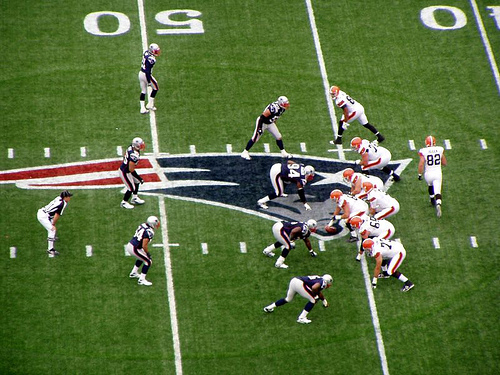
That’s a 4-3, right? Nope, not in this case. See that 4th defensive player on the left up front? See how he’s in a 2-point stance (standing up), not a 3-point stance (one hand on the ground)? That’s because he’s a linebacker. He’s just playing on the defensive line on this play; he’s not one of the defensive linemen. This is still 3-4: 3 linemen, 4 linebackers, even though it looks like 4-3. The linebacker who is up front in this play probably isn’t going to act like a lineman – he’s not going to help block the offensive line – so he’s not part of the linemen equation. There are still 3 linemen, 4 linebackers.

Does all of that make sense?

If not, leave any and all questions in the comments below and we’ll chat about what’s still muddy!