History Lesson : Helmet Evolution

photo source

Guess when the first non-leather helmets were worn?

No really, guess.

Here are a few numbers to help you out.

Football in American started in earnest in the 1890’s.

Most guys weren’t even wearing helmets then.

The NFL was born in 1920.

Having some sort of head protection seemed like a good idea to most at this point, so players wore leather helmets (hence the term “leather heads”) which increased in size and padding as the years went on.

Plastic helmets became the standard in…

1949!!! How in the world those guys survived without helmets for all those years, I’ll never know. Oh my word.

But we do know the story of how plastic helmets came into existence, and it’s actually really good.

Ready?

Ok, so, Riddell, the company that still makes the NFL’s helmets, made the first plastic prototype in 1939. But then World War II happened, so making harder helmets for men who were playing a game, not fighting a war, became less of a priority. Thus, the helmet construction process slowed down quite a bit until materials became more widely available.

In 1949, Riddell produced a much, much better model of their original 1939 edition, and it soon became the official helmet of the NFL. It even featured a leather chin strap! But you might not recognize it for lack of one missing feature:

photo source

The face mask. Oh, the face mask. Who needs ’em, am I right?!

Otto Graham may beg to differ. Here’s that portion of the story, straight from Riddell:

All NFL players were maskless until the Browns’ home game against the 49ers where Otto Graham took an elbow to the face, ripping open the side of his mouth near the end of the half. His coach, Paul Brown, had a lucite prototype put on Otto’s helmet by the team equipment Manager. Otto insisted on playing the second half. Paul Brown owned the patent for the face mask made by Riddell and used his profits to create the Cincinnati Bengals.

As they say, necessity is the mother of invention. And the mother of the Browns/Bengals rivalry.

Today, with all of the legitimate concern over head trauma, helmets are heading into a whole new era. Riddell has developed several revolutionary models which feature sensors that measure impact and determine whether or not it’s safe for a player to continue playing. The sensors can even transmit wireless messages to coaches on the sidelines when a player has exceeded the predetermined impact capacity and needs to be evaluated before getting cleared to go back out on the field. Given the gravity of the situation, it’s an encouraging prospect. And just look at how far we’ve already come since the leather head days!

Reason to be optimistic for the future, I think.

Film Room : Bucs vs. Saints

Before we begin, let’s talk.

You’re going to see something terrible on this week’s film.

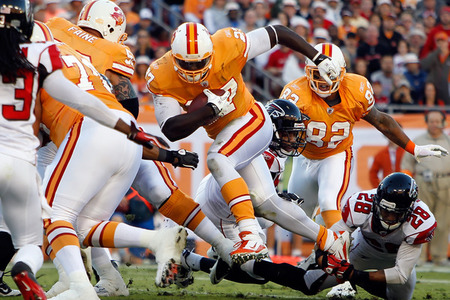
And that something terrible is the Bucs infamous creamsicle throwback jerseys.

photo source

They’re something special – when special is used in the southern “bless your heart” kind of way. I really thought they were the worst jerseys in the NFL, but then this happened and I had to reevaluate. Current status: third worst. So watch with caution:

Ok, let’s review what happened:

1st Down (Get Off the Line)

Defensive tackle Cedric Ellis explodes off the line of scrimmage as soon as the ball is snapped. It’s this speed and power  that enables him to avoid the left guard who is trying to get “across his face” – which sounds like football lingo but it means just what it sounds like it means – the guard is trying to get to the other side of Ellis’s face to pull him outside and open up a lane for the running back. Since Ellis beat the guard off the line, he was able to split the gap in the offensive line (run through it) and block the running back.

2nd Down (Staying Home on the Backside)

“Staying home on the backside” doesn’t sound like something many people would want to do. It doesn’t sound all that appealing. But it’s actually not that bad. It just means that the defender – in this case, safety Roman Harper – is going to stay where he assigned in the alignment (staying home), which on this play turns out to be the side the ball isn’t moving toward (the backside). So staying home on the backside means staying where you were originally designed to be even if the ball carrier goes in the opposite direction. You can see how this would wreak havoc on a player’s natural instinct to run toward the ball, thus making Harper’s disciplined, veteran move all the more praiseworthy. Because he doesn’t panic, he’s able to help his teammates close the inside gaps and prevent the running back from getting into the end zone.

And that’s not even his last highlight! Well done, Roman, well done.

3rd Down (Closing Down the Line)

It sounds like something you do at the end of a shift at a grocery store, right? But all this means is that safety Malcolm Jenkins doesn’t make a beeline to the backfield just because that’s where the ball is at the moment. The Saints are great at making good decisions based on fundamentals regardless of circumstances (and can’t we all use a little bit of that in real life, too?). Instead of rushing to the quarterback or running back, Jenkins stays close to the offensive line, running in line with the heels of the offensive lineman until he can read where the running back is headed and make the tackle inside. If he had gone straight to the running back immediately, he would have gotten there too late and missed the tackle. Good fundamentals led him to make the perfect stop for a loss.

4th Down (Staying in Coverage)

Once again we see Roman Harper doing his job like a boss. He doesn’t freak out and go straight to the backfield. He stays in the end zone, covering the tight end and taking him out of the play as a potential target, just as he was assigned. He trusts him teammates to get to Freeman and put pressure on him as well, which they do.

And thus: a perfect goal line stand. Four downs, zero points.

Off the Field : Charles Tillman

On the field, cornerback Charles Tillman is a nightmare for any opposing offense. The Packers get to face him twice a year, and even though 12 doesn’t give up many interceptions, you always have to pay extra attention to the guy they call “Peanut.” He’s 10 years into a great career and seems to get better and better all the time.

Charles’ legacy off the field was inspired in-part when his infant daughter, Tiana, was diagnosed with a heart defect and needed a heart transplant. Here’s their story straight from Peanut:

The Charles Tillman Cornerstone Foundation was established in 2005, three years prior to the Tillman family’s own battle with a childhood illness. Since it’s inception, the Foundation has helped over one million children and families in the greater Chicago area through five unique programs:

Charles’ Locker provides kids and families in hospitals with access to iPads, laptops, and other electronic devices during their stay to make the transition from home a little easier. Field of Dreams is like Charles’ own version of the Make-a-Wish foundation, in which children who are battling illnesses receive a sports-related wish granted of their choosing. Holiday Celebration is a December event in which Charles and his wife travel to local hospitals to spread holiday cheer. TendHER Heart Luncheon is a well-deserved break for mothers of children fighting illnesses. Each spring, selected moms are invited to attend a special luncheon to have a day away to themselves. The Tiana Fund, named after Tillman’s daughter, provides economic assistance to families in need.

In short: The Charles Tillman Cornerstone Foundation is blessing the socks off Chicago.

Keep up the great work, Charles!

Fundamentals : Five Common Offensive Schemes

For the next few weeks we are going to be all about offense. Specifically, we’re going to be talking about schemes, formations, and plays.

It wasn’t that long ago when all of the above sounded interchangeable to me. Isn’t a scheme the same as a formation the same as a play? Nope! Here’s how it all breaks down:

football, basics, schemes

So first comes scheme, then comes formation, then comes plays. Got it? Let’s move on!

Today, we’re going to be focusing on defining a few of the most common offensive schemes. Just as a note – a team’s scheme isn’t like a team’s name: it’s transient. Just because a team runs one scheme primarily doesn’t mean they only run that scheme – most teams run a combination of schemes throughout the course of one game. We’ll spend more time in the next few weeks going over specifics, but for today, here’s a general introduction to five schemes you are guaranteed to see in the NFL:

Pro Set (or Pro Style) Offense

It won’t come as a huge surprise, given the name, that this is the offensive scheme most pro teams run. Even if they don’t exclusively operate out of a pro style offense, they usually run at least some plays out of the pro set. In this scheme, the offense has the option to run or pass. The QB takes the snap from under center and can either hand the ball off to a running back or drop back and pass to a receiver. You’ll recognize it instantly on the field and on paper because it’s a very classic offense in the NFL – QB under center, RB’s in the backfield, WR’s split outside. Here’s what it typically looks like:

Pro Set formation

image source

West Coast Offense

The West Coast Offense, pioneered by Bill Walsh back in the glory days of San Francisco, isn’t so much an alignment of players as it is an offensive strategy. Teams running this offense use a combination of short-yardage passing plays to open up the opportunity for longer-yardage running and passing plays. Instead of advancing the ball by running first, as in the traditional model, the West Coast Offense utilizes short-yardage passing plays to advance the ball.

Option Offense (Spread, Read/Zone, Pistol)

This is the talk of the town in the NFL right now. The Option Offenses, which until quite recently were regarded as college, not pro, offenses, made quite a splash in the NFL this season. Rookie QB’s Russell Wilson and RG3 along with first-year and Super Bowl starter Colin Kaepernick all run option style offenses, and they all had phenomenal seasons. Is the option here to stay or is just a fad, like the short-lived success of the Wildcat? Only time will tell, but until then, we’ll have a lot of exciting games to watch.

So, what is an option offense? We’ll be talking much (MUCH) more about this in weeks to come; there’s just too much to dissect in a single blog post. In short, Option Offenses do exactly as their name suggests: they give the QB several options of plays to run – plays which he decides on both prior to the snap and during the course of the play. It’s a complex system and necessitates a savvy, athletic quarterback who is quick to make sound decisions and able to run or pass on the fly.

No Huddle Offense

This style of offense, like the West Coast Offense, isn’t so much about alignment as it is about execution. In the No Huddle, teams do just that: they don’t huddle up before the play. Instead, they rely on the quarterback to disseminate information about the play while the team is on their way to the line of scrimmage or they can also go with a predefined combination of plays in succession. The advantage of the No Huddle is to never give the defense a chance to catch their breath. Not only will they tire more quickly, they’ll also have far less time to make adjustments and run their preferred defensive schemes. The New England Patriots are the best in the biz at executing a No Huddle offense effectively.

Hurry Up Offense

While similar to the No Huddle, the Hurry Up Offense is different in that it is usually run in the final minutes of the half, not regularly throughout the course of the game. Teams often go into Hurry Up mode when they need to preserve time on the clock and get down the field as fast as possible.

While this is certainly not a definitive list of NFL schemes, you’re more likely to see these than most. Next week, we’ll dive a little further into the option schemes and see what all the commotion is about!

Personal Quiz: now that you are more familiar with these schemes, can you pick the one your favorite team uses the most? If you’re not sure, look it up and learn more about it! You’ll appreciate the offense in a whole new way!

News and Notes : 3.8.13

football, newsWe’re kind of in that awkward middle school stage of offseason news. The combine is over, the draft hasn’t happened yet, some guys are getting contracts, some guys are getting cut. The real season of change – free agency – doesn’t start until March 12. So this was a bit of a limbo week. The notable events were as follows:

Shawne Merriman Retires

Merriman had a good career; most of his highlight reel will come from his days as a San Diego Charger. He’ll retire as a 3-time Pro Bowler with 45.5 sacks. While he certainly contributed to the defense in Buffalo, he hasn’t really been the Shawne Merriman of old for the past few years, likely due to knee injuries.

(This loss is still unfortunate for the Buffalo Bills defense, which also lost Chris Kelsay to retirement this offseason. 2013 Optimism for Buffalo is on a steady decline already…and that’s saying something.)

Dwayne Bowe Makes Money

The Chiefs wide receiver signed a 5 year, $56 million dollar deal this week.

And if you think that’s a good pay day…

Joe Flacco Makes A Lot of Money

The Ravens quarterback signed a 6 year, $120 million dollar deal this week.

That’s unfathomable to me. And more than a little absurd. But let’s move on…

Revis Is On His Own Island

Clearly, he no longer resides on the alternate universe known as the Jets headquarters. (Revis, I have to say, I don’t think that’s a bad move. It’s crazy over there.) The only question is his forwarding address, since the rumors about a move to San Fran or Atlanta seem to be unsubstantiated.

Roger Goodell, Defined

For anyone who has a hard time understanding why the Commish is the way he is, perhaps this article will help. It’s an interesting and educational look inside the man who rules pro football. As someone who is trying to beat down doors in my own career journey, I really appreciated learning about the way he got his start:

Goodell began by writing letters to all 28 teams. He also sought a job — any job — from the NFL commissioner, Pete Rozelle. “Dear Mr. Rozelle,” Goodell wrote on July 2, 1981, “I’m writing to you in reference to any job openings you may have in your offices.” Over nine months, Don Weiss, the NFL’s executive director, received nearly a dozen letters from Goodell beseeching him for an interview. In April of 1982, Goodell got a phone call from Weiss asking whether he was in the New York City area. Goodell was seven hours away but said yes and made it for an interview the next day. He landed an internship in the secretarial pool, clipping newspaper articles and fetching coffee for the league’s public relations department.

Mr. Goodell, you can be expecting my call/email/letter/carrier pigeon.

Another week, another sign we all have too much time on our hands in the off-season:

Star Wars Connections in the NFL.

Is it September 5th yet?

(Although, I have to say, Brett Keisel as Chewbacca might be one of the best things I’ve seen this week.)

History Lesson : Thanksgiving (in Detroit, not Plymouth)

photo source

Thanksgiving.

You’re thinking turkey, of course. Probably family and pie, too. But you’re also thinking football, right? Aside from the Super Bowl itself, I doubt there’s a day of the year more synonymous with football than Thanksgiving.

So…why? How did that get started?

It began with the Lions. Hence the annual Lions game on Thanksgiving, for better or for worse (and, sorry, Detroit – it’s usually for worse). In 1934 the Portsmouth Spartans moved to Detroit and became the Detroit Lions.

(Although, aren’t we all just a little surprised that there isn’t an NFL team named the Spartans? Especially in the company of Cardinals and Ravens and Dolphins and Colts…a veritable zoo of animals that will leave the terror right out of your heart?)

(I realize I’m a fan of the Packers, which doesn’t necessarily strike fear into the heart of an opponent by name alone. But it’s such a rich history! Maybe that will be a history series in the future: team name origins.)

(Have I digressed?)

So, in 1934, the Spartans catch the midnight train to Detroit and become the Lions. Local radio executive George A. Richards purchased the team and was looking for a way to get a little of the limelight off of baseball and onto football. So he opted for a holiday game in an attempt to lure fans in during the team’s first year in the city.

And lure he did! The 26,000 tickets for the game sold out 2 weeks in advance, and it was estimated that nearly double would have been sold had they been available.

Not too shabby for their first year in town!

This was no homecoming game, no easy victory set up so that the home team comes out on top. This was a clash of the titans: the hometown Lions, who had lasted 8 straight games without allowing a touchdown (um, wow) and had a 10-1 record, and the rival Chicago Bears, who were one game better at 11-0 coming into the game.

They left 12-0.

The Bears took the division title that year, but roles would be reversed in the following year, when Detroit went on to win the Thanksgiving game (again against the Bears) and the 1935 Championship as well.

And, save for a small streak in the late 30’s and early 40’s, the Lions have played every Thanksgiving game since in one of the best Thanksgiving traditions since turkey. The Cowboys became a perennial Thanksgiving staple during the 60’s, and teams have rotated in and out of the Turkey Day schedule ever since it began, but it all started with the Lions.

Good job, Detroit. We’re thankful for you.