Surviving the Super Bowl : Special Teams

football, basics, teamsIt’s hard to imagine that often times all of the complicated scheming and hard-fought battles between offenses and defenses are ultimately decided by one guy’s leg…but more often than not in a close game, that’s exactly what happens. It all comes down to a kick.

There are five types of kicks to be aware of, and you’re probably familiar with most of them:

1. Kickoffs: Kickoffs happen after scoring drives and at the beginning of each half. A coin is flipped at the beginning of the game to determine who kicks off first (the winner of the coin toss gets to decide whether they want to kick off first (and therefore play defense first) or defer to the second half (and therefore play offense first), a decision entirely based on strategy, not whim).

2. Punts: Teams punt the ball away when they have reached 4th down and don’t believe it wise (or possible) to try and get the extra yardage they need to get to the first down marker. (We talked about punts in more detail in the 4th down section of the basics of offense post, if you need a refresher.)

3. Field Goals: If a team is near the end zone and can’t score a touchdown in 3 downs, they’ll likely kick a field goal on 4th down. Field goals are worth 3 points. You might have noticed that the distance from the line of scrimmage to the end zone and the distance from the line of scrimmage to a field goal are different. You’re right! If a team is at the 30-yard line on 3rd down, they’ll be kicking a 47 yard field goal attempt, not a 30 yard field goal attempt. That’s because 17 yards are added to the distance to account for the 10 yards of end zone (the goal post is at the back of the end zone) and the space between where the line of scrimmage is and where the kicker lines up (7 yards away).

4. Extra Points: After a team scores a touchdown (6 points), they line up to kick an extra point (…you guessed it: 1 point!), for a total of 7 points. Barring a penalty, extra points are kicked from the 2-yard line. (If a team is behind and needs to catch up or even/exceed the score, they might “go for two,” which means that instead of kicking an extra point after a touchdown, they’ll line up at the 2 yard line and try to get the ball in the end zone. If they do, it’s worth 2 points.)

5. Onside Kicks: If a team is down by a lot of points late in the game and is slated to kick the ball off to the other team, they might attempt an onside kick to regain possession of the ball and try to score more points on offense. You’ll notice an onside kick attempt quickly and easily because the teams stand much closer to each other than they do for normal kickoffs. In an onside kick, the ball is kicked low to the ground and travels like a skipping rock. It must travel at least 10 yards, but the kicker will try to keep it as close to 10 yards as possible to give his team a greater chance of recovering the ball, since the other team is lined up closer than usual and has a greater likelihood of reaching the ball first. (For much more on onside kicks, see this post.)

* 6. Drop Kicks: Yesterday, my friend Jason politely pointed out that I had missed a category of kicks: drop kicks. And he was right! (And just a side note – that’s why I love writing this blog: I get to learn from writing the posts AND from all of you guys. So please never hesitate to bring up a question or point out something that might have been overlooked. It helps make the site better, and I’m all for that!) Drop kicks happen every once in a blue moon (literally), but are important to know about because they can easily catch the opposing team off-guard. As defined by the NFL rulebook, a drop kick is “a kick by a kicker who drops the ball and kicks it as, or immediately after, it touches the ground.” A team can drop kick a field goal or an extra point, but they can also drop kick a fair catch. A player signaling for the fair catch of a punt can receive the punt and then drop kick the ball in a field goal attempt. For more information about drop kicks, see this article. Thanks, Jason!

All of the kicking plays described above are executed by the special teams unit – an ironically named bunch seeing as how they usually get the short end of the respect stick. But special teams can truly make or break a season for a team. Have you ever seen a complete momentum shift after a team that was down returns a kickoff for a touchdown? That’s all special teams. How about when a team misses an opportunity to go to the playoffs due to missed field goal in the final seconds of the game? That’s special teams, too. It’s the unit that is either a team’s best friend or worst enemy.

The special teams unit is responsible for any play that involves punting or kicking. The placekicker and the punter are specialized positions specifically for the special teams unit. Those players only play on special teams. But guys who play on offense and defense can, and usually do, have a role in special teams as well as a roll on offense or defense. You might have heard of Wes Welker, who has long been one of the Patriots best wide receivers, but has also been a star on the return team. Ditto: Chicago’s Devin Hester (although Hester primarily shines in special teams). More often than not, though, rookies and second-string players are relegated to the less glamorous positions on the special teams units because they haven’t earned playing time on offense or defense yet.

And there you have it! Next week we’ll have a final review (hint: a quiz) to make sure you’re 100% ready, but if you’ve made it through the offense, defense, and special teams posts over the past few weeks, you are well on your way to Surviving the Super Bowl! Way to go!

(Do your own touchdown dance. Come on, just do it! You know you want to.)

What to Know : After Conference Championshps

football, games, conference

The Super Bowl matchup we’ve always wondered about is on it’s way. The HarBowl has gone from curious possibility to reality.

Who knew?!

But first, let’s talk about Sunday’s games.

Game 1: Niners at Falcons (Niners 28, Falcons 24)

What We Learned: The #1 Seed falls yet again. Neither the Falcons (#1 NFC) nor the Broncos (#1 AFC) will be representing their conference in the Super Bowl this year, which proves once more that the elusive #1 Seed can be more of a curse than a blessing. 2009 was the last time a #1 NFC Seed won the Super Bowl (Saints), and you have to go all the way back to 2003 to a time when the #1 AFC Seed won the Super Bowl (Patriots). Teams can’t, and wouldn’t/shouldn’t try not to have the best record in their conference – that defeats the whole point of playing the game. But it just goes to show that when the postseason arrives, everything goes out the window. It’s a new season and a level playing field. (If you’re interested in the whole seeding vs. success thing, which is really intriguing, read this story by ESPN.)

For the second week in a row, the Falcons took off with a scorching lead – 17-0 right out of the gate! And for the second week in a row, they allowed their opponent to come back – only this time, their opponent won. The comeback wasn’t as all-consuming this week as last week – it was more like a slow creep onto the scoreboard mixed with a few fatal errors from the Falcons – but it was a comeback all the same. The Falcons weren’t able to convert in the red zone on 4th down late in the 4th quarter following a hotly debated catch call, and that kind of sealed the deal for them.

What’s Next?: Little brother vs. big brother in Super Bowl XLVII.

Game 2: Ravens at Patriots (Ravens 28, Patriots 13)

What We Learned: Ray Lewis was right! No weapon formed against the Ravens has prospered. Even this one: Tom Brady was formerly 67-0 against all opponents at home when going into halftime with the lead. That was quite the record, but the Ravens smashed it on Sunday. The defense was a thing of beauty, disrupting Tom Brady and rarely allowing classic Patriot-esque quick, big plays. The Patriots fabled clock management? Completely thrown off. Joe Flacco wasn’t a hindrance to the Ravens cause, either. He had the offense firing on all cylinders  in the second half (and Anquan Boldin? Hello!)

What’s Next?: Big brother vs. little brother in Super Bowl XLVII.

Well, This Is Weird:

Both Harbaugh teams were road teams.

Both road teams won.

Both scored a total of 28 points.

Both shut out their opponents in the second half.

Wow.

I was pulling for the Falcons, but I have to admit that it’ll be a fun historic moment to have two brothers coaching against each other in the Super Bowl, and on paper it seems like a great game. Congratulations to both teams!

How about you guys? Did the games turn out as you hoped? Are you excited for the Super Bowl???

Wait…What Just Happened? : Catch?

football, advanced, catchLate in the Niners at Falcons game last night, Falcons receiver Harry Douglas kept the Falcons Super Bowl hopes alive with a big catch late in the game.

Or was it?

It’s one of those plays that is virtually impossible to call, especially since what defines a “catch” has changed in recent years. In days gone by, a catch wasn’t a catch unless the ball was completely controlled by the receiver. If there was any movement and it looked like the ball hit the ground, it was probably going to be ruled incomplete. But recently, it seems like the calls tend to favor the receivers.

Be that as it may, here’s what happened:

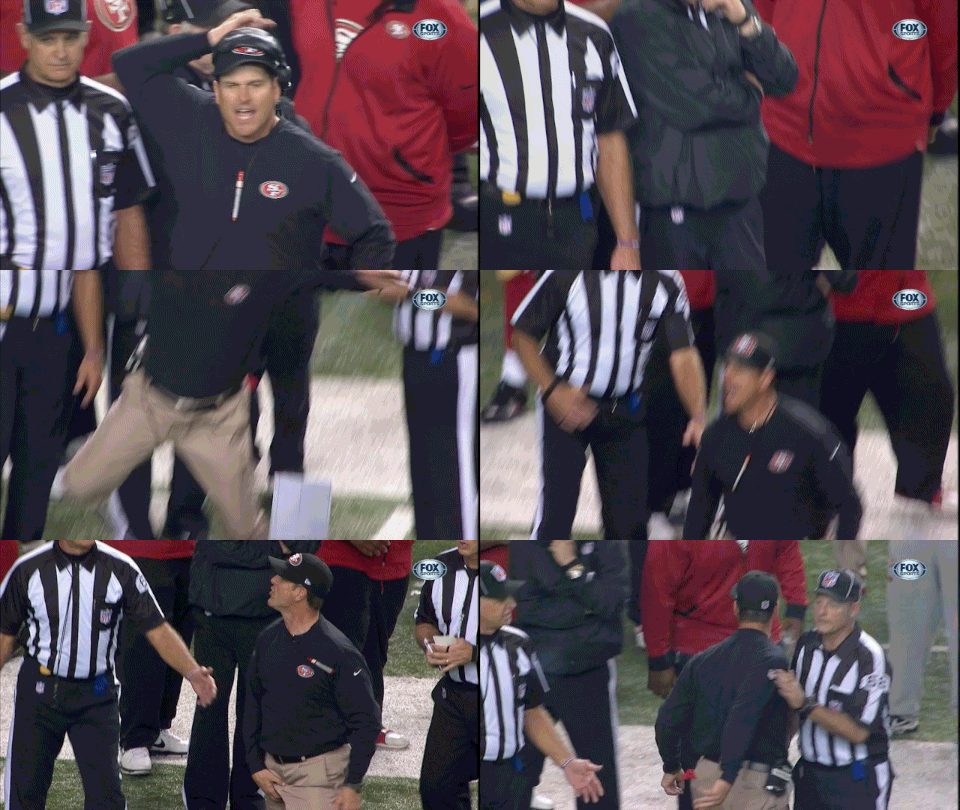
Douglas appears to have control of the ball all the way to the ground. Once he goes to the ground…it’s unclear. While the ball does move around a bit, his left hand seems to cover the ball at all times, indicating that he never lost control of the ball. Consequently, the refs called it a catch.

Jim Harbaugh subsequently flipped out, which is so out of character for him. He then threw the challenge flag.

One thing to note about challenged calls – there has to be indisputable evidence that the call was wrong to be overturned. In the face of mediocre (aka: inconclusive) evidence, the call is going to stand every time.

Since there wasn’t clear evidence that the ball came out and hit the ground while outside of the receiver’s control, the call stood.

Luckily, Jim Harbaugh didn’t lose his cool.

It ended up not giving the Falcons an advantage anyway though, since the Niners got a huge fourth-down stop and the Falcons turned the ball over on downs.

What do you guys think? Catch or not a catch?

What to Know : Conference Championship Weekend

football, games, championshipThe road to the Super Bowl will end this Sunday, with four teams battling for two spots and the right to play in New Orleans on February 3rd. The winners of the NFC and AFC Championship games will advance to the ultimate game: Super Bowl XLVII. Here’s what you need to know:

NFC Championship Game

49ers at Falcons

Sunday, January 20th, 3pm (FOX)

What to know from history: The NFL has always struggled a bit with geography. Some tutoring may be in order here. But for one reason or another, the San Francisco 49ers (in California) and the Atlanta Falcons (in GEORGIA) at one time both resided in the NFC West division. (There was also a time when the Arizona Cardinals lived in the NFC East. Riddle me that.) Because of their former divisional association, these two teams have played each other quite a few times. San Francisco bears the lead with 44 wins to Atlanta’s 3o – but let’s remember that the Falcons were pretty bad for a pretty long time in that era, and the 49ers were in their heyday. The last time they met in the playoffs was in 1999 and the Falcons won by 2 points to advance to the NFC Championship game. The last time they’ve played each other in recent history was in 2010 – a game that the Falcons also won, again by 2 points. The Falcons have won 4 of their last 5 against the 49ers…but again, let’s remember that until recently, the 49ers haven’t been a competitive team. Both teams look much different these days.

What to know on Sunday: You can pretty much throw history out the window on this one. On it’s face, it looks like this game is San Francisco’s to lose. I can’t remember the last time a home playoff team was slated to be such an overwhelming underdog. The Niners have the momentum and the scary-good quarterback who hasn’t figured out that he shouldn’t be playing this well this early in his postseason career yet, but the Falcons have a chip. A gigantic chip. It’s a chip on their shoulder from years of winning the regular season but never winning the playoffs, for hundreds of analysts and fans and colleagues who never took them seriously this year even though they were undefeated for more than half of the regular season. On top of that, they experienced watching their postseason dreams die right in front of them last week as the Seahawks came roaring back to put up a fight in the second half. The Falcons struggled to regain the lead…but they did. It might be just the change-of-history the Falcons need to really make a run at this thing.

AFC Championship Game

Ravens at Patriots

Sunday, January 20th, 6:30pm (CBS)

What to know from history: This exact same game was played in this exact same place almost exactly a year ago. (This concludes the usage of the word “exact.”) The Patriots won that game after then-Ravens kicker Billy Cundiff missed a 32 yard field goal that would have sent the game into overtime. To say that the Ravens are out for vindication would be an understatement. They’ve played each other since then – the Ravens won their regular season game against the Patriots earlier this year – but that game was valiantly won for Torrey Smith, the Ravens wide receiver who had lost his brother just hours prior. In this matchup, the Ravens will be looking to rectify what happened last January and send Ray Lewis out with one more trip to the Super Bowl.

What to know on Sunday: Make no mistake: New England is the favorite in this game. Baltimore might have all of the emotion, but New England has the knockout punch. It would be logical to assume that the reinjury Rob Gronkowski suffered on Sunday to his broken forearm would have put a wrench in the Patriots offense. But The Hoodie doesn’t do wrenches. He just pulls another tool out of the shed and gets back to work. How else do you explain Shane Vereen, a kid who played scarcely enough to score 4 touchdowns all season, coming into the game and scoring 3 touchdowns in one night. Such is the legend of the Patriots, who never seem to find the bottom of their depth chart.

My prediction: I think we’re looking at a Niners/Patriots Super Bowl. But personally? I’ll be rooting for the Falcons and the Ravens. I’d love to see both of those teams get in.

How about you guys? What outcomes will you be hoping for this weekend?

Game Play Thursday : Forward Progress

football, advanced, forwardSo you’re rooting for a team. Let’s say, the Packers. (Total coincidence.) And they’re playing the Bears. It’s 3rd and 5 at the Bears 35 yard line, Bears on offense. They need to get to the 40 yard line (3rd and 5 = 5 yards) to get a first down.

Cutler throws a pass out to Marshall, who catches it at the 40 yard line but gets tackled mid-catch and brought back to the 35 yard line.

So what just happened? Is it a first down? Or was there no yardage gained on the play?

If you guessed first down, you are right! If you think that’s weird and goes against everything you know about football, you are also right! That’s why today, we’re going to talk about our friend Forward Progress.

*Now, let’s pause for a mini rant. I just Google searched “forward progress” to come up with the actual rule/definition…and nearly an hour later, I just found it by manually going to the 100+ page NFL rulebook and finding it myself. Why this didn’t occur to me initially is a subject we can tackle at a later date…but seriously?! This is case in point why I created this website. Because it’s entirely impossible to find solid basics quickly…or, you know, at all. Moving on.

Here’s what the NFL rulebook has to say:

forward progress

And here’s what that means:

1. When being spotted on the field, the football is placed lengthwise (with the tips pointing toward the end zone).

2. If a player, while catching a ball, is pushed backwards by a defender, the ball will be declared dead. This means that it’s no longer “live” or in play at the spot where the player was pushed backwards.  Instead, “forward progress” is awarded, which means that the ball will be spotted wherever the player established control, not where he was pushed backwards.

And here’s the even easier version:

Guys who tackle are no joke. So at the risk of anyone who goes up for a ball never gaining actual yardage because of getting pushed back by defenders while they’re still in the air, forward progress comes into play to speak on behalf of inertia. Forward progress is the advocate for where the ball would have been spotted had it not been for a tractor trailer of humanity coming full steam ahead.

You may also have seen this rule come into play on running plays, when a running back charges ahead and then is pushed back several yards when a swarm of defenders descends upon him and forces him back. The ball will be spotted at the furthest point forward in which the running back had control of the ball and forward momentum.

There are also other variations of the rule, which seem to surface whenever refs feel like spotting the ball in a place where it did not actually land. But basically, if you have control of the ball and you are moving/attempting to move forward, you’re going to be awarded the spot that is most advantageous to your progress, even if you were pushed several yards back by defenders. That’s why you’ll see players stretch the ball out as far as they can, tuck it back in to their bodies, and still be awarded the spot farthest away in the name of forward progress.

This rule just seems weird to me, based on the fact that this is football, not golf. It’s a contact sport. So it’s odd that there are rules in place that negate the effects of said contact. The rules for player safety make sense. I think those are completely reasonable and necessary. But forward progress isn’t about safety, it’s about giving advantageous placement of the ball to the ball carrier, which just seems contradictory to the competitive nature of the game, in my opinion.

What do you guys think? First and foremost – does the rule make sense? And if so, do you like it?

Surviving the Super Bowl : The Basics of Defense

If you survived The Basics of Offense last week, you’re in luck. The Basics of Defense is much easier (the intricacies of defense, not so much – but that’s another post for another day). You’re going to breeze right through this, I know it!

First, let’s talk about who’s on the field and what they generally do:

football, defense, basics

A standard defense gets divided into two sections: the defensive front (7 players) and the defensive backs (4 players).

The Defensive Front:

Defensive Tackles (DT): The defensive tackles play on the inside of the defensive line (the line of players directly across from the offensive line). In a 3-4 system, as pictured above (3 defensive linemen and 4 linebackers), the defensive tackle is the player in the middle and is called the nose tackle. Don’t worry too much about the particulars, just know that the defensive tackles are in place to stop running plays as well as contain the offensive linemen in front of them (or him, if there’s only a nose tackle in place).

Defensive Ends (DE): The defensive ends play on the outside of the defensive line. If the offense runs the ball, the defensive end on the side of the run needs to stop the run. If it’s a passing play, the defensive end will rush (run at full speed) the quarterback in an attempt to sack him (tackle him to the ground).

Linebackers: There are several types of linebackers – you can learn more about the Mike, Sam, and Will linebackers in the glossary. What’s important to know is that linebackers are the teams best tacklers; they are responsible for guarding against both running and passing plays.

The Defensive Backs ( also known as the “secondary”):

Cornerbacks: Cornerbacks generally line up near the line of scrimmage directly across from the offense’s best wide receivers. You’d be right to wonder why they are called cornerbacks and collectively known as defensive backs if they play up front with the defensive front. You’re not crazy – that’s a legit question. Here’s the deal: as soon as the ball is snapped, the cornerbacks will backpeddle and take off running toward the backfield to cover the wide receivers who are also running in that direction (toward the end zone). So cornerbacks line up in the front of the formation, but in a split second they’ll be sprinting to the backfield, waiting to make a play on a long ball.

Safeties: Safeties generally play towards the inside and can move up to the front or to the back depending on their position. The free safety (FS) usually lines up the farthest back and defends the deep middle of the field against passing plays. His goal is to break up the pass or intercept the ball. The strong safety (SS) defends against the run and the pass; he lines up closer to the front of the formation, usually covering the tight end. (General Note: whatever side of the formation the tight end lines up on is called the “strong side” because he’s an extra player added to that side, which is why the safety covering the tight end is called the “strong” safety. See, it all connects!)

Putting It All Together:

So you know who these guys are and what they do. Now it’s time to translate that to what you’ll see this weekend while watching the games.

In general, you’ll rarely see a defense as straight forward as the one diagrammed above. It’s pretty vanilla. But you can easily tell what kind of play the defense is anticipating  just by where all of the players are lined up, even if you’re unsure of who’s who in a complicated formation. It couldn’t be easier.

Are the majority of players bunched up toward the front of the line? The defense is expecting a run. Remember when we talked about 8 in the box? Anytime the defense brings more than the standard 7 players into the box (the part of the field where the linemen and linebackers play), you can be fairly sure that the defense is either planning on blitzing the quarterback or stopping a running play. (And remember – the cornerbacks don’t count. They’re outside of the box, on the edges of the formation.)

Are the majority of players spaced out in the backfield? The defense is expecting a pass. The defense usually employs specific packages for this type of situation. In a nickel package, a linebacker is taken off the field and an extra defensive back is put in (because there can only be 11 players on the field for each unit at all times, so they’d have to swap players in and out). In a dime package, two linebackers are taken out and two defensive backs are put in. The more defensive backs, the more chance the defense has of breaking up a pass or intercepting it.

And if you’re thinking either scheme leaves the defense vulnerable in one way or another – you’re right. If everyone is up front expecting a running play, the offense might be tempted to try a bomb downfield. If everyone is spread out in pass coverage, the offense might have an opportunity to run through an obvious hole up front. It’s always a gamble – but that’s what makes football so much fun to watch!

Does all of this make sense? Do you feel more comfortable watching a game now that you know what the offense and the defense do and how they’re trying to beat each other? If you have any questions, leave ’em in the comments and I’ll be happy to help!