Best of Fundamentals: The Snap

Originally posted here on March 4, 2013

The snap is not found on a winter jacket. Nor is it a dance move inspired by Legally Blond. In football, the snap is one of the most important exchanges that happens in game.

If you’re not watching closely, it might seem as if the quarterback has the ball in his hands from the start of the play and just does with it as he pleases. But this is not true. Thecenter – literally the guy in the center of the offensive line – has the ball at the beginning of the play. He sets it on the ground and puts his hand on it like so:

photo source

(Team choice completely unbiased.)

Once he gets set, he’ll tilt the ball at a bit of an angle so that he can get a good grip. If at any point the center’s head is lined up ahead of the football, that’s an encroachment penalty, which would back the offense up 5 yards.

Types of Snaps

The action of a snap never changes: one player is going to “hike” the ball between his legs to another player, which essentially means that the ball is going to go from in front of him to behind him. How that happens depends on the play at hand. Generally, there are two snaps that happen in classic offensive formations:

1. Under Center

If the QB takes the snap under center, he’s literally standing right behind the center, with his hands in a personal location under the center’s rear end. Here’s Joe Flacco and Matt Birk getting to know each other a little better:

photo source

2. From the Shotgun

In the shotgun formation, the bonding session between quarterback and center is eliminated. The QB is lined up a few yards behind the center, and the center hikes the ball back to him from the line of scrimmage. Here’s Tom Brady and Dan Koppen embracing their personal space:

photo source

Just to be confusing, there’s also a few other forms of snaps to add to the list:

3. Direct Snap

Sometimes, teams run a special formation called the Wildcat formation in which a player other than the quarterback (usually a running back) receives the snap. When this happens, it’s called a direct snap.

4. Indirect Snap

Or, the sneaky version of the direct snap. In this snap attempt, the quarterback is standing next to or near a running back and from all appearances it looks like the QB is going to be the one receiving the snap. But what actually happens is the center snaps the ball to the running back while the quarterback fakes that the snap either went over his head or was fumbled. This happens most frequently in punting situations when the offense wants to try to convert the down rather than continue with the punt.

5. Long Snap

Centers don’t get to have all of the fun. The Special Teams unit – the unit responsible for kicking plays – employs a specific player just for snapping the ball called the longsnapper. It’s his job to make those long snaps effectively every time. (He can usually also be a backup offensive lineman if need be.)

Bad Things That Can Happen

In every snap’s life, a little rain must fall. Snaps can be fumbled – when the football gets mishandled and leads to a failed secure exchange between QB and center. There can also be illegal motion, encroachment, or false starts at the time of the snap – when players are not set, lined up correctly, or moving too soon when the ball is being snapped. If the ball isn’t snapped before the play clock expires, that’s a delay of game penalty and will cost the offense 5 yards. There are a litany of other rules regarding what happens surrounding a snap, but those are three situations you’ll see more than most.

Snap Counts

If the center snapped the ball on the same signal on every play, the defense would catch on quickly and be able to anticipate the snap, therefore getting the fastest possible start. To keep the defense from gaining any advantages, quarterbacks use a snap count, or a designated signal (either verbal or nonverbal) on which he wants the ball to be snapped. Teams often try to confuse a savvy defense by using a hard count – a fake snap count designed to draw the other team offsides.

Questions, comments, concerns, something I left out? You know where to find me!

Best of Fundamentals: 53-man Roster

Originally posted here on February 18, 2013

We’re going to start with the one thing you need to play a football game, other than a football:

A team.

There are 53 men on each NFL team. Clearly, they don’t all play at the same time. Here’s the breakdown:

football, basics, roster


So each week, 46 men dress to take the field. Those are the “active” players. The 7 players on the practice squad (also called the scout team) are “inactive” players – they are still on the roster, but they aren’t allowed to enter the game.

We know that even though a team might have 3 tight ends, 4 running backs, and 5 wide receivers on their active roster that not all of them are going to be on the field at the same time. Not only would that be a massacre waiting to happen (the offensive line does more than just protect the quarterback), it would also be illegal: each team can only have 11 men on the field at one time. Is the offense on the field? There can only be 11 guys out there. Defense? Same story. Special teams? Nothing special here: there are still only 11 men allowed on the field

from each team at one time.

So why are there so many men on the roster? If each unit only fields 11 players (and the special teams unit doesn’t even have it’s own specific set of players other than the 3 shown on the diagram), why are there 46 guys on the active roster?

Reason #1: Injuries. If one guy gets injured (and over the course of the season, pretty much every guy is getting injured), he’ll need a replacement. One of the second or third or fourth string guys will take the field to replace him.

Reason #2: Formations. Remember when we talked about personnel groups? And whenwe talked about defense before the Super Bowl? Teams utilize different players in different formations depending on the game plan they have in place. Maybe the offense sees that the other team’s defense is showing a weakness in the secondary so they want to try a passing play. They might field 10 personnel – 1 running back, 0 tight ends, and 4 wide receivers – to give the offense the best chance possible of gaining yardage on a long pass. Or maybe the defense, seeing that the other team’s offense is successfully converting on passing plays, wants to substitute in more defensive backs in either a nickel (5 DB’s) or a dime (6 DB’s) package to defend against the pass. Using different formations is an essential way that a team keeps the other team on it’s toes, guessing what they’re going to do.

If 53 men on the roster seems like a lot, remember that teams are allowed to bring 90 players into training camp. 90 players! So nearly half of those players get cut and keep training for their next opportunity. Being the coach who makes those cuts is a tough gig.

SO: 53 guys on a team. 46 active. 7 on the practice squad, or inactive. 11 on the field at one time.

Got it?

For more about who’s on the field, check out these posts:

The Basics : The Players

The Basics of Offense

The Basics of Defense

The Basics of Special Teams

Best of What Just Happened : Catch?

Originally posted here on January 21, 2013

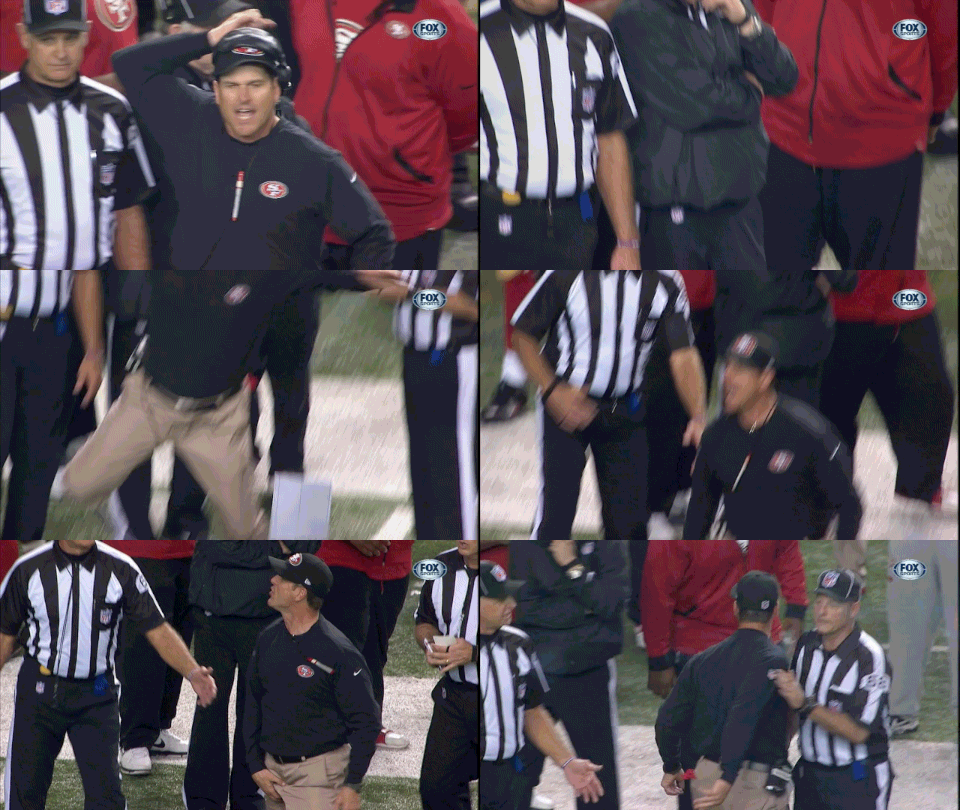
Late in the Niners at Falcons game last night, Falcons receiver Harry Douglas kept the Falcons Super Bowl hopes alive with a big catch late in the game.

Or was it?

It’s one of those plays that is virtually impossible to call, especially since what defines a “catch” has changed in recent years. In days gone by, a catch wasn’t a catch unless the ball was completely controlled by the receiver. If there was any movement and it looked like the ball hit the ground, it was probably going to be ruled incomplete. But recently, it seems like the calls tend to favor the receivers.

Be that as it may, here’s what happened:

Douglas appears to have control of the ball all the way to the ground. Once he goes to the ground…it’s unclear. While the ball does move around a bit, his left hand seems to cover the ball at all times, indicating that he never lost control of the ball. Consequently, the refs called it a catch.

Jim Harbaugh subsequently flipped out, which is so out of character for him. He then threw the challenge flag.

One thing to note about challenged calls – there has to be indisputable evidence that the call was wrong to be overturned. In the face of mediocre (aka: inconclusive) evidence, the call is going to stand every time.

Since there wasn’t clear evidence that the ball came out and hit the ground while outside of the receiver’s control, the call stood.

Luckily, Jim Harbaugh didn’t lose his cool.

It ended up not giving the Falcons an advantage anyway though, since the Niners got a huge fourth-down stop and the Falcons turned the ball over on downs.

What do you guys think? Catch or not a catch?

Best of What Just Happened : Fumble Recovery

Originally posted here on January 7, 2013

Another week, another chat about flaws in the Coach’s Challenge system.

Early in yesterday’s Colts at Ravens playoff game, Ravens running back Ray Rice fumbled the ball, the Colts recovered it, and then a Ravens player emerged from the pile with the football.

So, sequence: Ravens fumble, Colts recover, Colts lose possession, Ravens dig it out and re-recover it.

The official call: Colts football.

Now at first glance, this is a weird call. If a player emerges from the bottom of a pile with the football, you’d assume he had the final possession of the football. But more often than not things get ugly at the bottom of the pile and players scrap for the ball even after the play is dead (when the whistle has been blown) to try and get possession. So in that light, it would make sense that the official (Mike Carey) who called Colts ball saw more than we did on TV and knew that the Colts had possession of the ball when the play was over, not the Ravens.

However, on second glance, it looks like the original sequence was right on: Ray Rice fumbled, the Colts recovered but lost the ball, and the Ravens re-recovered the ball at the bottom of the pile. It seemed like pretty solid evidence that if reviewed, the ball would be given to the Ravens.

But Ravens head coach John Harbaugh couldn’t do anything about the bad call. Remember what we learned about the Coach’s Challenge system? There are a bunch of plays that coaches can’t challenge, including fumbles. So even though it was clearly a bad call, the Ravens just had to get over it and keep playing (which they did, to the tune of a turnover of their own later that drive).

Next week, we’ll talk about something other than the issues with the Challenge system. Promise.

Best of What Just Happened : Punt

Originally posted here on December 17, 2012

In last night’s Niners at Patriots game there was a substantial debacle over a potential muffed punt.

Between multiple fouls and Ed Hochuli’s classic method of explanation and his microphone cutting in and out due to inclement weather…it was one big confusing mess. Honestly, I’m still confused. But let’s try to break it down as best we can:

What Happened:

The Patriots punted the ball on 4th down. Ted Ginn Jr., a member of the 49ers special teams unit on that particular play, appeared to have potentially touched the football as the ball hit the ground and was bobbling around. The Patriots then appeared to have recovered the ball.

What That Means:

Members of the kicking team (the team that is punting the ball) cannot touch the ball before a member of the receiving team (the team receiving the punt) touches the ball. If they do, it’s a violation. However, if a member of the receiving team touches the ball but does not have possession of the ball (doesn’t catch it or have it in his hands) the kicking team can legally recover the ball (by falling on it or picking it up – any way of gaining possession) and therefore gain possession.

Terms To Know Before We Get Down To The Nitty Gritty:

muffed punt is when a player touches the football prior to possessing the football. This can happen when the football inadvertently hits a member of the kicking team, or, as in our example, the football touches a member of the receiving team but is not possessed by that player.

An illegal touch (which I believe is synonymous with first touch) is when a member of the kicking team touches the football before a member of the receiving team touches the football. This is a violation, not a foul. (I’m still working on it, but I think the difference between a foul and a violation is that fouls are flagged penalties and violations are not flagged but are leveraged against the team committing the violation.)

Downing the ball is when the ball hits the ground and a member of the kicking team touches it to “down the ball” – or have it called dead – right where it is. You usually see this when a punter pins the ball deep into the opposing teams territory and members of the kicking team attempt to keep it from rolling into the end zone. If they down the ball before it reaches the end zone, it will be positioned wherever they downed it (the 5 yard line, the 2 yard line, etc), but if it goes into the end zone it is ruled a touchback and will be brought out to the 20 yard line, which gives the other team much better field position.

Confusing and not relevant to our current conversation but IMPORTANT:

Downing the ball DOES constitute an illegal touch. However, since it’s a violation and not a foul, it doesn’t carry adverse consequences for the kicking team. If the kicking team downs the ball, it is an insurance policy for a receiver on the receiving team who may want to pick the ball up and return it. Since downing the ball is an illegal touch (first touch) violation, the ball will automatically be spotted at that position (or at the most advantageous position for the receiving team if there were multiple first touches) if the receiver does decide to pick up the ball and return it and fumbles it or loses yardage in the process.

The Result:

Let’s go back to the play in question. The Patriots punted, it looked as if the ball may have touched a 49ers player, and the Patriots recovered the ball. (We’re not even going to get into the other penalties called on the play because illegal touching can’t offset any penalties (because it’s a violation, not a foul) so they were going to stand anyway.)

Bill Belichick thought the punt was muffed. We learned above that a muffed punt is when a player from the receiving team, in this case, Ted Ginn Jr. of the 49ers, touches the ball before possessing the ball. Upon further review, it was decided that the punt was not muffed – it did not touch Ted Ginn Jr. before being touched by the Patriots.

MINI QUIZ:

Now we have a situation in which the kicking team touched the ball before the receiving team had a chance to touch the ball. And what does that mean?

You got it! Illegal Touching/First Touching by the Patriots, which results in the 49ers getting to choose the most advantageous first touch to spot the ball.

Here’s the actual rule that was cited in the call:

” ‘First touching’ is when a player of the kicking team touches a scrimmage kick that is beyond the line of scrimmage before it has been touched by a player of the receiving team beyond the line. If the ball is first touched by a player of the kicking team, it remains in play.

“First touching is a violation, and the receivers shall have the option of taking possession of the ball at the spot of first touching, provided no penalty is accepted on the play, or at the spot where the ball is dead. First touching does not offset a foul by the receivers. There may be multiple ‘first touch’ spots, if more than one player of the kicking team touches the ball before it is touched by a player of the receiving team.”

And there you have it: the most confusing way to start a Monday. Holy cow.

Best of What Just Happened : Coach’s Challenge

Originally posted here on November 26, 2012

You may have tuned into the Texans at Lions game on Thanksgiving and witnessed the enforcement of one of the weirder rules that exists in the NFL these days involving the coach’s challenge.

On the play in question, Texans running back Justin Forsett was clearly down – his elbow and knee both touching the field – but the whistle never blew, which meant the play was still live. Kudos to Forsett, who had the awareness to get up and keep running…all 81 yards to score a touchdown.

Under normal circumstances, this play would have been reviewed and called back. There’s no way that call would have stood. There are a number of plays that areautomatically reviewed by the Replay Official. They include:

  • all scoring plays
  • interceptions
  • fumbles
  • backward passes that are recovered by an opponent or go out of bounds through an opponent’s end zone
  • muffed scrimmage kicks recovered by the kicking team
  • any questionable plays after the two-minute warning of each half
  • any questionable plays throughout any overtime period

So, here’s the sequence of normal events:

1. A play is made that results in a touchdown.

2. The scoring play is reviewed upstairs because all scoring plays are reviewed to be sure everything was kosher and the play actually resulted in the score awarded (feet in-bounds, control of the ball, etc).

But that’s not what happened on Thursday. Seeing that the play was ruled a touchdown, Lions head coach Jim Schwartz (understandably) flipped and threw the red coaches challenge flag. (Coaches get two challenges per game. If they are wrong about the play in question, they are charged one time out. If they are right, the call is reversed. If they are right both times, they earn an extra challenge.) However, a scoring play is among the plays that are automatically reviewed by the Replay Official. That means that it is NOT able to be challenged by a coach, and there is a hefty penalty for throwing the challenge flag anyway: a 15 yard penalty, AND the play is no longer reviewable. The ruling on the field stands. This is what happened to Jim Schwartz on Thanksgiving.

1. Justin Forsett’s play was ruled a touchdown.

2. Jim Schwartz believed that Forsett was down 81 yards ago and throws the challenge flag.

3. Since the play would have been reviewed anyway and the gesture of throwing the challenge flag is seen as a delay of game tactic, a 15 yard penalty was enforced and the play was rendered unreviewable. The ruling on the field stood, even though it was clearly wrong.

So the Texans earned a touchdown that would have been overturned, and went on to win 34-31 in overtime. It stands to reason that if the call had been reversed, the outcome of the game would have been very different.

It’s a pretty harsh rule, admittedly. So much so that the NFL came out and said they’re going to change it in the off-season, or potentially sooner. I think everyone is in agreement that it’s a good idea.